
In September 2024, I spent a weekend building an AR Ganesha idol using only AI tools. It worked, and it is still live. But getting there took four tools and five separate steps.
I generated the idol in Midjourney and Leonardo, compared them, and picked the Midjourney one. Then I went to Hugging Face and ran it through two different image-to-3D models, SF3D and InstantMesh, before settling on SF3D because the mesh quality was better and it let me add environment lighting. I exported to GLB. I asked Claude 3.5 Sonnet to write me an HTML page that would open the camera and place the model on a surface. Then I uploaded the file to my server, pointed the HTML at the GLB and added a title.
Five steps. Four tools. One weekend. I wrote the whole thing up at the time, step by step.
This year I did something more ambitious in about twenty-five minutes, and I never left one browser tab.
What I built with GPT-6 Astra
GPT-6 Astra is OpenAI’s frontier model, released on 3 September 2026. OpenAI calls it its most powerful model yet, and its president Greg Brockman has gone as far as suggesting it might be remembered as the arrival of AGI. Make of that what you will.
The claim that caught my eye was narrower and more testable. OpenAI says Astra is state-of-the-art on 3D and CAD-style work, and its launch page claims the model can build a house in Blender and turn it into a walkable Unreal Engine 5 scene. That is a very specific promise. I wanted to see what it meant in practice.
I have been circling the same question every Ganesh Chaturthi: what is the next level of interaction I can build around it? In 2024 the answer was an idol you could place in your living room. This year I wanted something you could play.
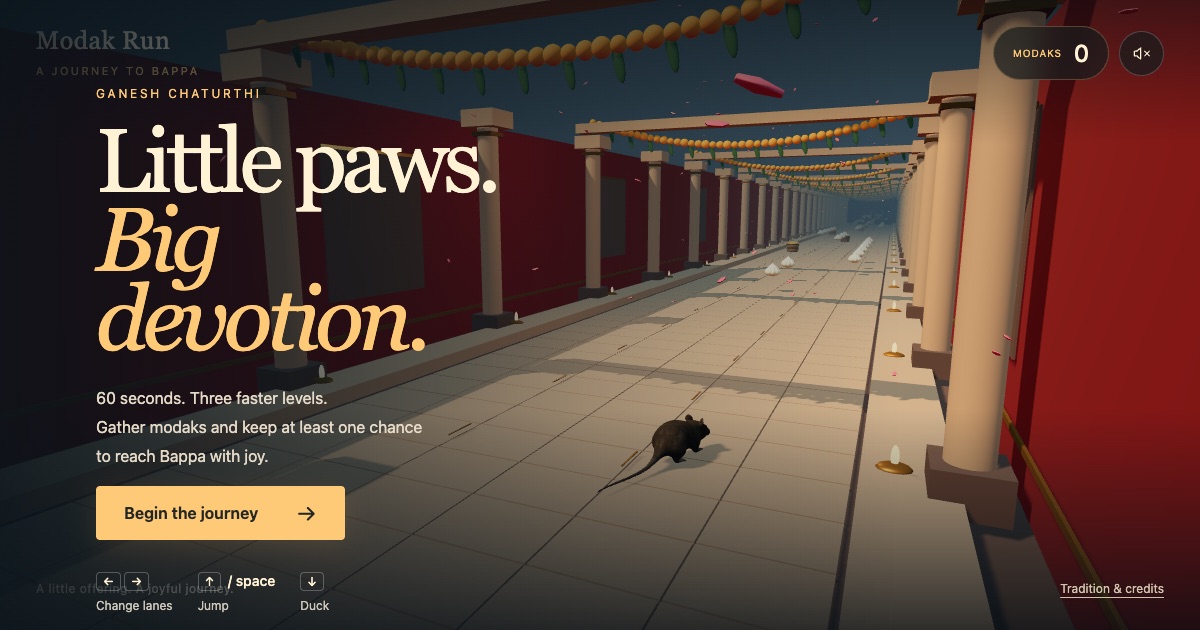
The idea was simple enough. Ganesha’s vehicle is the mooshak, the mighty mouse. So you run as the mouse, you collect modaks along the way, and you reach the shrine at the end. A Temple Run for Ganesh Chaturthi.
I described exactly that, in a paragraph, in plain language. Here is what came back:
- A playable 3D endless runner, mobile and desktop
- A mouse character with running, jumping and ducking
- Modaks to collect, physics that behave
- Festive decoration throughout
- A Ganesha shrine reveal at the end
- Optional sound
- Arrow keys and space on desktop, swipe or on-screen buttons on mobile
The core game came out of the first paragraph. A second pass added the mechanics — a 60-second timer, three difficulty levels that speed up every 20 seconds, and a shrine that appears whether you win or lose. Win and there are petals and celebration. Lose and the mouse cries at the shrine.
It is live now, if you would rather play than read: Modak Run · A journey to Bappa. It runs in the browser on phone and desktop, and there is nothing to install.
That second pass is the part worth paying attention to, and I will come back to it.
The prompt
Here is the consolidated version, with everything I ended up wanting folded into a single brief. Take it, change the theme, make your own:
Create a single page HTML game with the theme of Ganesh Chaturthi. It has to work on both mobile and desktop. It is a small racing game similar to Subway Surfers or Temple Run, where the character is a mouse running towards a Ganesha statue at the end and collecting modaks on the way. Look at Indian mythology and work on realistic 3D characters. Make it as realistic as possible in terms of physics, the look and feel of the characters, and the final frame where the Ganesha statue is revealed. Use 3D models wherever applicable and source them from open source forums and networks. Add small details to make it feel festive and celebratory. The game should have a 1 minute timer and 3 levels that get tougher at each level in terms of speed. The final Ganesha statue should always appear whether we win or lose. If we win it should be celebratory, and if we lose the mouse should cry. Let me know if you need any help.
Nothing clever in there. No role-playing, no formatting tricks, no “you are an expert game developer.” Just a clear description of what I wanted, the way I would explain it to a person.
What actually changed
It is tempting to say the difference between 2024 and 2026 is that the model got smarter. That is true, but it is not the interesting part.
Look at what the 2024 workflow actually was. Every one of those five steps was me acting as the integration layer. Midjourney did not know what SF3D needed. SF3D did not know what model-viewer expected. Claude did not know what my server looked like. I was the one carrying files between tools, deciding what good output looked like at each stage, and making the handoffs work. The AI did the generating. I did the plumbing.
This year the plumbing disappeared. One system held the whole job — the 3D, the physics, the interaction logic, the mobile controls, the packaging — and I never had to think about handoffs at all.
Which brings me back to that second pass. The first paragraph got me a game. The second one got me a game worth playing, because a 60-second timer and three difficulty levels are not a technical requirement. They are a design decision. Nothing in the first brief was wrong. It was just underspecified in the way most briefs are underspecified, and the gap was taste, not capability.
That is the shift I would actually bet on. When the plumbing goes away, the scarce thing stops being whether you can build it and becomes whether you know what to ask for, and whether you can tell that what came back is not quite right yet. Which is, more or less, the job I have been doing for twenty years.
Try it yourself
Play Modak Run first, then take the prompt above. Change the mouse to something else, change the festival, change the whole genre. I want to try a pixel art version next, and something more immersive after that.
If you build something, I would like to see it.
Happy Ganesh Chaturthi. May Bappa bless you all with joy, luck and prosperity.