
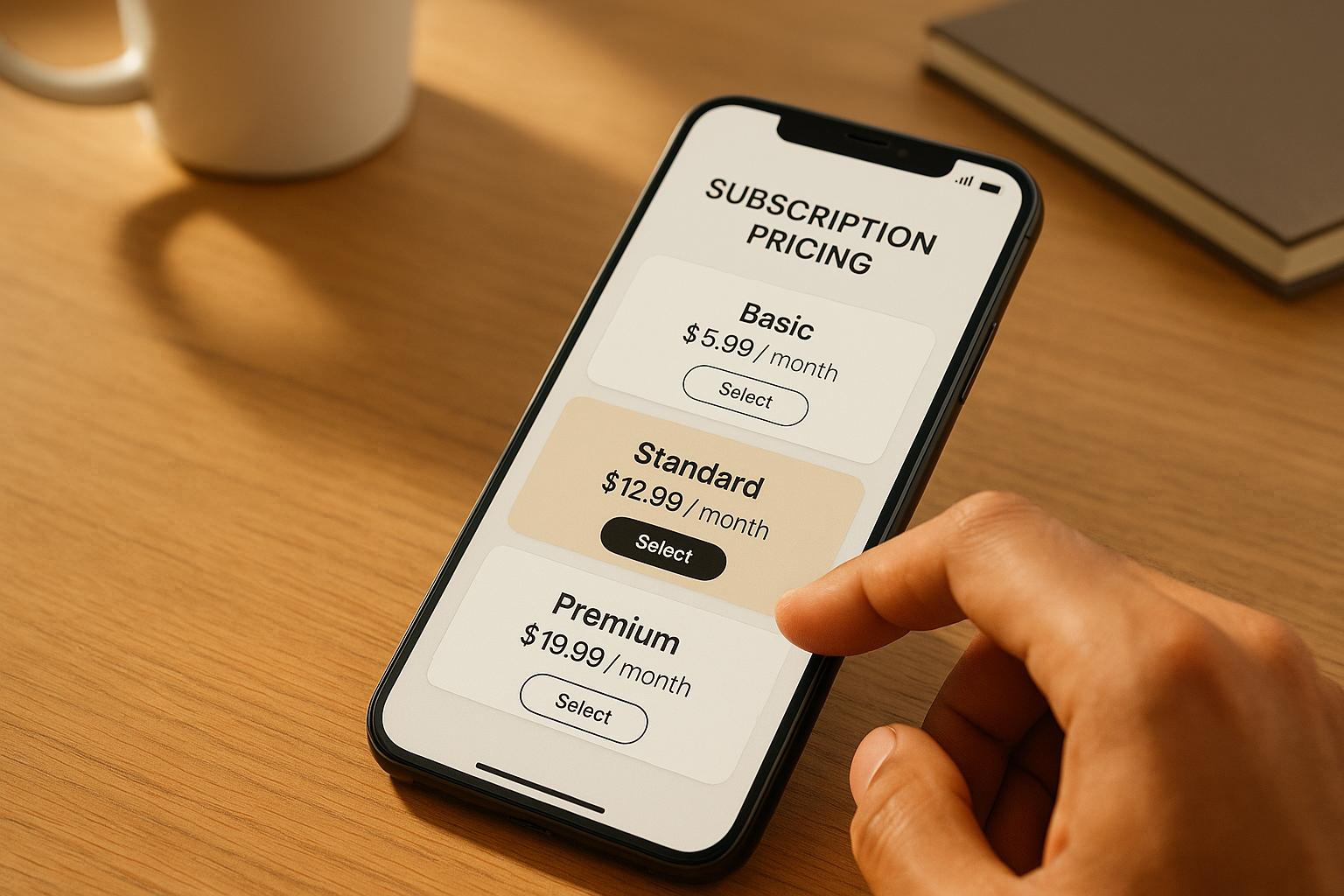
Mobile app subscriptions are changing fast in 2025. Rising costs, economic pressures, and evolving consumer habits are forcing developers to rethink pricing strategies. Here’s what’s happening:
- Higher prices: Developers are increasing fees to cover growing costs like AI integration and platform charges.
- Fewer free trials: Apps are moving toward upfront payments or shorter trials to attract committed users.
- Hybrid models: Combining subscriptions with ads or one-time purchases is boosting user lifetime value by 30%.
- AI-driven pricing: Apps are using AI to set dynamic, personalized prices, increasing profits by up to 10%.
- Flexible payments: Digital wallets dominate, with 90% of Americans using them and younger generations demanding more options.
- Regulatory changes: Apple’s updated App Store rules now allow external payment links, giving developers more control.
Consumers are spending $33.58 per month on app subscriptions, but they demand clear pricing and value. Developers are responding with smarter, data-driven strategies to retain users and maximize revenue.
How the Best Subscription Apps Print Money in 2025
Key Trends in Mobile App Subscription Pricing
As developers face mounting costs and changing user expectations, subscription pricing strategies for mobile apps are undergoing significant changes. In 2025, three key trends are shaping how apps approach pricing, driven by economic pressures and advancements in technology.
Higher Subscription Fees to Offset Costs
The rising costs of app development, integrating AI technologies, and meeting compliance requirements – including platform fees ranging from 15% to 30% – are pushing developers to increase subscription prices. Expenses related to security, user acquisition (which can cost between $1.50 and $5 per install), and ongoing operations are further straining budgets.
To manage these costs, developers are exploring ways to optimize their processes. For instance, using cross-platform frameworks like Flutter and React Native can reduce development expenses by 30–40% compared to native development. Additionally, smart backend design and API optimization help cut cloud-related costs without sacrificing app performance. These financial pressures are also influencing how apps approach trials and monetization strategies.
Fewer Free Trials, More Upfront Payments
The popularity of free trials is waning, prompting developers to rethink their strategies. According to Recurly‘s 2025 State of Subscriptions report, free trial conversion rates have dropped from 46% to 33%. This decline is leading many apps to prioritize attracting high-quality subscribers from the outset.
Strict paywall models are proving to be more effective at converting users into paying customers. Apps using hard paywalls achieve a median conversion rate of 12.11%, compared to just 2.18% for freemium apps. This model is particularly successful for Health & Fitness, Education, and Business apps, where users are often willing to pay upfront for premium content.
For apps that still offer trials, optimizing the onboarding process is critical. Data shows that 82% of trial starts happen on the day the app is installed, making first impressions essential. Top-performing apps achieve a 20.3% trial start rate – well above the median of 6.2%. As Marcus Burke, a Meta Ads & App Growth Consultant, puts it:
"Focus on quality trials, not just quantity"
The length of trials is also evolving. Trials lasting between 17 and 32 days have the highest median conversion rate at 45.7%. These findings suggest that giving users more time to experience the app’s value can lead to better results. By combining upfront payments with flexible pricing strategies, apps are finding new ways to improve conversions and revenue.
Growth of Mixed Monetization Models
Hybrid monetization is becoming a go-to strategy for developers looking to maximize revenue while meeting the needs of diverse user groups. Currently, 35% of apps combine subscriptions with consumables or lifetime purchase options. This approach is delivering strong results, with apps using hybrid models reporting a 30% increase in user lifetime value compared to those relying on a single revenue stream.
The market data is compelling. Global mobile ad spending is expected to hit $390 billion in 2025, while in-app purchase revenue on iOS and Google Play reached $150 billion in 2024. Additionally, 82% of non-gaming apps now pair subscription models with app advertising.
As the Content & Insights Team at Adjust notes:
"Hybrid monetization isn’t just a trend – it’s a reflection of how diverse and dynamic today’s app audiences really are. By offering multiple paths to value, developers can build more resilient revenue models while giving users more choice in how they engage."
For example, ad-supported free tiers can effectively drive subscription growth when implemented thoughtfully. Success in mixed monetization depends on understanding user behavior and testing different elements like ad placements, subscription tiers, and pricing models to find what works best for each audience segment.
These trends highlight how rising costs, changes in trial effectiveness, and the adoption of hybrid revenue strategies are reshaping mobile app subscription pricing in 2025.
User Preferences and Market Changes in Subscription Pricing
In the United States, shifting consumer habits are reshaping how subscription services are priced. With the average American spending $33.58 per month on app subscriptions, users are becoming more discerning about where their money goes. Rising costs and evolving market dynamics have prompted many to demand greater clarity and flexibility in pricing. These changes are driving a shift in expectations for subscription services.
Demand for Clear and Flexible Pricing
Americans are increasingly focused on transparency and value when selecting subscription apps. A surprising 42% admit to forgetting about recurring fees they’re paying, making clear pricing and communicated value a priority.
The numbers tell an interesting story. The median app price in the U.S. now stands at $29.99, with premium apps costing nearly three times as much. Monthly subscriptions average $15.20, while annual plans hover around $44.60. Weekly plans are also gaining popularity, with the average price rising to $8.10, a 12.5% jump from the previous year.
To meet these demands, apps are turning to AI-driven segmentation to personalize pricing based on user behavior and interests. Subscribers, who are 18 times more valuable than anonymous users, benefit from dynamic paywalls that adjust to their engagement patterns. This strategy is proving effective, as Eric Crowley, Partner at GP Bullhound, suggests:
"Experiment, go premium, and communicate value clearly"
Apps with hard paywalls are seeing better results in turning downloads into paying users compared to freemium models. Higher prices, when paired with well-communicated value, are driving stronger lifetime value. Additionally, 20% of new subscribers come from return acquisitions, showing that a clear value proposition keeps users coming back.
Smooth Payment and Checkout Experiences
Payment flexibility is a top priority for U.S. consumers. Research reveals that 81% of users find flexible payment options important, with 43% rating them as very important. Younger generations, particularly Millennials (53%) and Gen Z (49%), place even greater emphasis on this flexibility.
Digital wallets are leading the way. Nearly 90% of Americans use digital payment methods, and 44% expect digital wallets to become even more common by 2025. Among Gen Z, this number climbs to 60%, with 37% of them anticipating that digital wallets will handle most of their transactions within the next few years. A significant 18% of Gen Z respondents even expect to rely exclusively on digital wallets by 2025.
This trend is pushing app developers to offer more than just traditional credit card payments. Weekly, monthly, and annual subscription plans are now standard, catering to different financial preferences. Weekly plans, in particular, are driving strong lifetime value in categories like Productivity and Utilities, while annual plans perform better in areas such as Health & Fitness, Photo & Video, and Education.
Impact of Regulatory and Distribution Changes
Regulatory changes are also shaking up subscription pricing strategies in the U.S. market. In May 2025, Apple updated its App Store guidelines following a court ruling in the Epic Games case. This update allows developers to direct users to their own websites for purchases and removes warnings about external links. For developers, this means more control over pricing and customer relationships without Apple taking a commission.
The effects have been immediate. Spotify, for instance, successfully updated its app to include an external "Go Premium" button, enabling users to view subscription prices and pay directly on the web. Apple’s response to the court ruling was clear:
"We strongly disagree with the decision. We will comply with the court’s order and we will appeal"
Currently, these changes are limited to the U.S. App Store, giving American developers a unique advantage in experimenting with external payment systems while staying compliant for global markets.
This new regulatory environment reflects a broader move toward consumer-focused pricing models. As Peter Houston, Co-founder of Media Voices, puts it:
"The bottom line for subscriptions is that people don’t want to waste money or time on them. So many people have a bloated subscription stack and the reckoning is coming."
To thrive in this shifting landscape, apps are prioritizing retention over acquisition. Features like flexible payment plans, subscription pause options, and clear communication of value are becoming essential for long-term success.
Mobile app developers are increasingly using data-driven strategies to fine-tune subscription pricing, balancing profitability with user satisfaction. Let’s explore how technology is reshaping subscription pricing models.
AI-Driven Pricing Optimization
Artificial intelligence is changing the game when it comes to setting and adjusting subscription prices. AI-powered dynamic pricing adapts in real time, factoring in demand, competition, and user behavior. By analyzing patterns, it enables precise price adjustments that can significantly impact revenue.
In fact, AI pricing has been shown to increase gross profits by 5–10% and boost revenues by up to 15% within just six months. This approach also enhances customer retention by offering personalized pricing strategies that resonate with individual users.
Some big names have already demonstrated the power of AI pricing. For instance:
- Amazon adjusts prices on millions of items in real time using AI to factor in competition, demand, and inventory.
- Uber uses surge pricing, which dynamically changes fares based on supply and demand.
- Airbnb leverages AI to analyze local events, seasonal trends, and competitor rates, helping hosts optimize rental prices.
For developers, adopting AI-driven pricing involves clear goal-setting, preparing data for analysis, and selecting the right tools that integrate seamlessly into existing systems. Testing these models in controlled environments is also crucial.
"AI-based dynamic pricing enables organizations to adjust pricing strategies based on shifts in demand, competitor behavior, and customer purchasing patterns."
However, transparency and ethical practices are essential to maintaining customer trust. This means training teams, establishing governance frameworks, and continuously monitoring performance.
sbb-itb-9ef3630
Niche and Tiered Pricing Models
Tiered pricing offers flexibility by catering to different user segments with plans that align with various budgets. This approach attracts a wider audience with entry-level options while providing premium features for users with more advanced needs.
The advantages are clear. Tiered models allow businesses to segment their audience effectively, offering tailored plans that match specific preferences. They also encourage upgrades by showcasing the added value in higher tiers.
Many successful apps have embraced this strategy:
- Spotify offers a three-tier model: a free, ad-supported Basic tier, a Standard Premium tier with offline downloads, and a Premium Family tier for multiple accounts at a reduced rate.
- Dropbox provides a free Basic tier with limited storage, a Standard Plus tier with more storage and basic sharing, and a Premium Professional tier with advanced features and priority support.
- Canva and Slack also use tiered structures to meet diverse user needs.
Despite its benefits, tiered pricing can present challenges. If the differences between tiers aren’t clear, users might feel confused. Additionally, each tier must deliver distinct value to avoid overlap that could cannibalize sales.
"If you’re not offering customers choices, you’re leaving money on the table and losing customers." – Z. John Zhang, PhD, Tsai Wan-Tsai Professor; Professor of Marketing; Director, Penn Wharton China Center
To implement tiered pricing effectively, developers should conduct thorough market research, gather regular feedback, and clearly define the unique benefits of each tier. Analyzing sales data and customer behavior helps refine the model over time.
Integration of Recurring Billing Platforms
Recurring billing platforms are now essential for managing subscriptions efficiently. These tools automate billing, streamline subscription management, and provide insights into revenue streams. With 79% of sales teams reporting revenue growth in the past year, having a reliable billing system is more critical than ever.
Leading platforms like Chargebee, Maxio, Recurly, and Stripe Billing offer features such as automated invoicing, flexible pricing options, and seamless integration with CRM and accounting tools. They also handle global payments, tax compliance, and revenue recognition, making financial management smoother.
Modern platforms go a step further with AI-driven tools, such as dunning management, which automates handling failed payments, sends personalized recovery emails, and uses retry logic to minimize churn.
"Recurring billing software uses AI to automate the entire billing process from start to finish, including handling free trials, cancellations and renewals." – Salesforce US
When choosing a billing platform, it’s important to define your business needs, compare options, and prioritize compatibility with your existing tools. Look for features like customizable billing frequencies, trial periods, and automated workflows. Excellent customer support and onboarding processes are also key considerations.
For app developers integrating AdTech strategies, these platforms can sync with advertising analytics, providing a clear view of user acquisition costs versus lifetime value. This alignment helps optimize pricing decisions and campaign performance. Experts like Abhilash Krishnan – Creative AdTech Strategist highlight the importance of linking billing systems with AdTech insights to achieve better results.
Comparison of Subscription Models
Let’s dive into how different subscription models stack up and what they mean for your mobile app’s revenue strategy. Picking the right approach can be the difference between steady growth and missed opportunities.
Standard vs. Mixed Monetization
Hybrid subscription models are gaining traction, and for good reason. Apps using these models have reported a 30% boost in user lifetime value compared to those sticking to a single revenue strategy. This shift mirrors evolving user expectations, with gaming apps leading the charge at 61.7% adoption, followed by social and lifestyle apps at 39.4%.
| Feature | Standard Subscription | Mixed Monetization |
|---|---|---|
| Revenue Source | Recurring subscription fees | Subscriptions, in-app purchases, ads |
| Flexibility | Limited; must subscribe for access | High; users can choose payment methods |
| Revenue Potential | Predictable but capped | Higher due to diversified streams |
| User Experience | Restrictive without free options | Adaptable with free tiers available |
Mixed monetization offers a broader appeal. While standard subscriptions provide steady, predictable income and help retain users, they can also lead to "subscription fatigue." On the other hand, hybrid models introduce flexibility, offering multiple ways for users to engage and pay. This approach not only captures a wider audience but also keeps the user experience positive by offering free or low-commitment options.
Free Trial vs. Upfront Fee Models
Free trial models – where users get full access for a limited time – have shown promising results, especially opt-out trials (where payment details are required upfront). These trials boast conversion rates around 50%, far outperforming opt-in trials, which hover at 18%. Overall, free trial models tend to convert at rates between 15% and 25%.
The choice between a free trial and an upfront fee depends heavily on your app’s complexity and perceived value:
- Free Trials: Ideal for apps with a steep learning curve or complex features. They give users the chance to explore the product before committing.
- Upfront Fees: Better suited for simpler apps with immediate, obvious benefits. Users are more likely to pay upfront if they’re already confident in the product’s value.
Each approach caters to different user needs. For instance, a fitness app with advanced analytics might benefit from a free trial, while a straightforward to-do list app could thrive with a one-time fee.
Fixed vs. AI-Driven Pricing Strategies
AI-driven pricing is transforming the way mobile apps generate revenue. Apps using AI-based pricing systems have reported gross profit increases of 5% to 10%.
| Feature | Fixed Pricing | AI-Driven Pricing |
|---|---|---|
| Price Adjustment | Static, manual changes | Dynamic, real-time optimization |
| Data Usage | Limited historical data | Detailed, user-specific data |
| Market Responsiveness | Slow to react | Quickly adapts to trends |
| Revenue Optimization | May miss peak opportunities | Maximizes revenue based on demand |
| Customer Perception | Predictable and transparent | Risk of perceived unfairness |
| Implementation | Simple setup and management | Requires technical expertise |
Fixed pricing is straightforward and easy to manage, but it lacks the flexibility to capitalize on market changes. In contrast, AI-driven pricing adjusts dynamically, using detailed user data like browsing habits, purchase history, and demographics. This approach helps maximize revenue opportunities, but transparency is crucial to avoid alienating users who might view fluctuating prices as unfair.
For developers leveraging advanced advertising technology, combining AI-driven pricing with ad analytics can supercharge both user acquisition and lifetime value. Experts such as Abhilash Krishnan – Creative AdTech Strategist emphasize the power of pairing creative strategies with AI tools to achieve high-impact campaign results.
Conclusion: The Future of Subscription Pricing in the U.S. Market
In 2023, app subscriptions in the U.S. generated a staggering $45.6 billion – accounting for more than half of global revenue – with 96% of spending on iOS and Google Play coming from subscriptions. These numbers highlight the immense opportunity for app developers as they refine their strategies for 2025.
Key Takeaways for App Developers and Marketers
To thrive in 2025, app developers need to focus on experimentation and user-first strategies. Data shows that the top 5% of newly launched apps earn over 400 times more in their first year than the bottom 25%.
Positioning apps as premium offerings can yield impressive results. Apps with higher subscription prices achieve a median lifetime value (LTV) of $55.21, compared to just $8.08 for lower-priced apps – a difference of nearly sevenfold. Additionally, premium apps boast better download-to-trial conversion rates (9.8% versus 4.3% for lower-priced apps). As Eric Crowley, Partner at GP Bullhound, advises:
"Experiment, go premium, and communicate value clearly"
Optimizing the user journey is equally critical. Since 82% of trial starts happen within the first day of installation, a seamless onboarding process can make or break an app’s success. Phil Carter, Founder and CEO at Elemental Growth, stresses:
"Optimizing onboarding flows to maximize trial start rates is a huge source of leverage for many subscription apps"
Mixed monetization models are also gaining popularity. Gaming apps lead the way, with 61.7% using this approach, followed by social and lifestyle apps at 39.4%. Retention remains a key challenge – apps offering lower-priced annual plans retain up to 36% of users after a year, compared to just 6.7% for high-priced monthly plans.
The Role of AdTech in Subscription Pricing
Advanced AdTech is reshaping how subscription pricing strategies are developed. Beyond traditional user acquisition, AdTech now plays a pivotal role in pricing optimization. With stricter privacy regulations, first-party data has become essential, while AI-powered tools enhance campaign performance and enable dynamic pricing models. Notably, 86% of advertisers report using AI-driven tools in their work.
Innovators like Abhilash Krishnan are leading the charge, blending mobile-first AdTech strategies with AI-driven creative automation. This combination of creativity and technology is redefining how subscription pricing strategies are executed.
AdTech consolidation is also creating new opportunities. Mergers and acquisitions, along with the explosive growth of retail media, are building a robust ecosystem for data-driven pricing strategies.
The future belongs to apps that seamlessly integrate subscription pricing with cutting-edge AdTech. By leveraging AI, first-party data, and creative automation, developers can craft strategies that not only attract users but also keep them engaged over the long term. North America continues to lead the way, with download-to-paying conversion rates of 5.5% in the upper quartile and 10.5% at the P90 level, showcasing the level of sophistication needed to succeed in the U.S. market.
FAQs
How are mobile app developers using AI to set smarter subscription prices, and what are the benefits?
Mobile app developers are using AI-driven tools to optimize subscription pricing by studying user behavior, preferences, and spending habits. These tools rely on predictive models to recommend pricing that users are more inclined to accept, striking the right balance between being budget-friendly and boosting profits.
This approach offers several advantages: higher revenue per user, more tailored user experiences, and smarter pricing strategies. With AI, developers can not only improve user retention and satisfaction but also increase app profitability – all while maintaining a competitive edge in the ever-changing subscription market.
How do changes to regulations, like Apple’s updated App Store rules, affect subscription pricing strategies for mobile apps?
Regulatory changes, like Apple’s updated App Store rules permitting external payment links and modifications to tax and fee structures, are altering how developers handle subscription pricing. These shifts push developers to adapt their strategies to ensure compliance while still catering to user demands.
In the U.S., many developers are turning to approaches such as tiered pricing, regional pricing adjustments, and promotional deals. These tactics aim to strike a balance between staying profitable and meeting both regulatory standards and changing consumer preferences.
Why are hybrid monetization models gaining popularity in mobile apps, and how do they boost user lifetime value?
Hybrid monetization models are gaining traction because they blend various revenue streams – like subscriptions, in-app purchases, and ads – to boost overall earnings. This approach allows businesses to tap into diverse user preferences, creating multiple ways to generate income instead of depending on just one method.
These models also help increase user lifetime value (LTV) by providing flexible options that encourage ongoing engagement. For example, users who might skip a subscription can still support revenue through ad views or occasional purchases. This ensures developers can benefit from a broader audience while keeping their offerings accessible.