

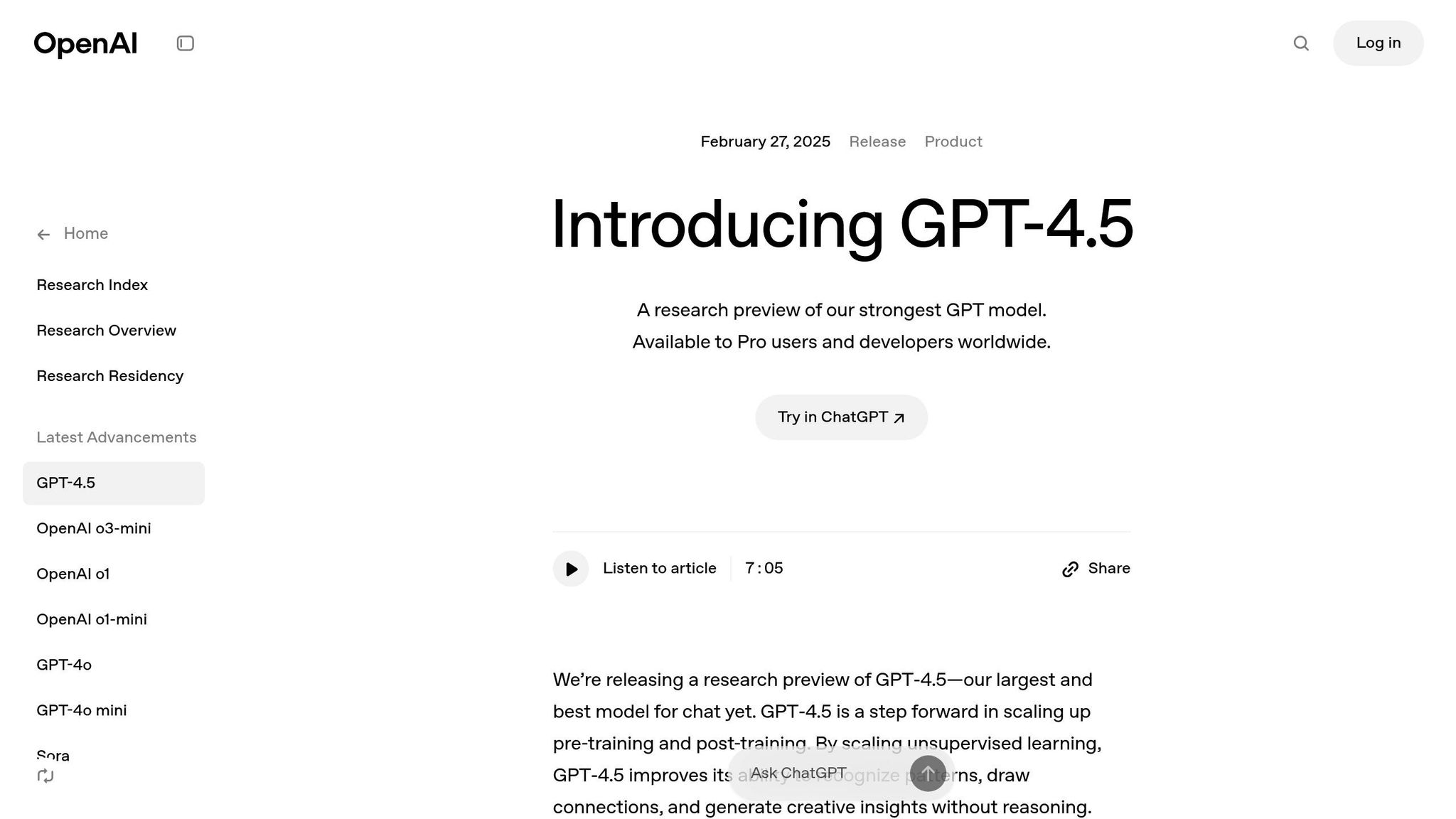
AI has officially passed the Turing Test, and it’s changing advertising in big ways. Large Language Models (LLMs) like GPT-4.5 now mimic human conversations so well that people can’t reliably tell the difference. This breakthrough is reshaping how brands connect with audiences.
Key Takeaways:
- Human-Like Interactions: GPT-4.5 achieved a 73% success rate in being judged as human, outperforming previous AI systems.
- Improved Personalization: LLMs use real-time data and persona-based prompts to create highly tailored ad experiences.
- Content Creation Revolution: AI now automates repetitive tasks, saving time and ensuring consistency in brand messaging.
- Ethical Concerns: Risks include job automation, misuse in deceptive ads, and trust issues without proper transparency.
What does this mean for you? AI-driven advertising is now more engaging, efficient, and scalable – but it also requires careful oversight to ensure responsible use. Keep reading to learn how this technology is transforming the industry and how to adapt responsibly.
🤖 GPT-4.5 Passes the Turing Test with Persona Prompting
Past Limitations of AI in Advertising
Before large language models (LLMs) advanced to a point where they could pass the Turing Test, earlier AI systems faced several challenges that limited their use in advertising. These issues shaped how brands approached AI for engagement and content creation.
Challenges with Consumer Trust
Early AI advertising tools often failed to build trust with consumers. Their responses were rigid and overly formulaic, making interactions feel impersonal. Pre-LLM chatbots, for instance, relied heavily on deflection tactics and canned responses. This often led to frustrating exchanges where the chatbot would shift topics or provide irrelevant answers when faced with complex questions.
"Passing the Turing Test is not a sensible goal for Artificial Intelligence." – Pat Hayes and Kenneth Ford
Take ELIZA as an example. It used basic pattern-matching techniques to simulate understanding but struggled to maintain meaningful conversations during longer interactions. These shortcomings, paired with limited personalization features, further eroded trust in early AI tools.
Limited Personalization Capabilities
Another major drawback of early AI systems was their basic approach to personalization. These systems could only manage surface-level customization, which failed to meet the growing demand for tailored consumer experiences. Here’s a breakdown of some of the limitations:
| Personalization Feature | Pre-LLM Shortcomings |
|---|---|
| Customer Segmentation | Targeted only broad demographics |
| Content Adaptation | Relied on simple templates |
| Response Generation | Chose from pre-written scripts |
| Interaction History | Retained minimal memory of past interactions |
| Context Understanding | Used basic rule-based patterns |
As a result, advertisers were stuck offering generic experiences with only slight variations, far from the personalized engagement consumers began to expect.
Bottlenecks in Content Creation
The inefficiencies of early AI systems also created significant roadblocks for marketing teams. Without advanced language understanding, these tools often required extensive human intervention. Some common challenges included:
- Spending extra time fixing AI-generated content
- Struggling to scale content production across multiple platforms
- Needing constant oversight to maintain a consistent brand voice
- Relying on manual processes for real-time content adjustments
These inefficiencies made it difficult for brands to keep up with the fast pace of modern marketing. The lack of advanced capabilities highlighted the need for more sophisticated AI solutions – a gap that LLMs are now filling effectively.
New Advertising Capabilities with LLMs
Engaging Customer Interactions
Advanced LLMs like GPT-4.5 now achieve 73% human-like interaction through persona-based prompts. This development is reshaping customer engagement across critical channels:
| Interaction Type | Key Improvement |
|---|---|
| Chat Support | Context-aware responses |
| Ad Copy | Dynamic text generation |
| Social Media | Real-time interactions |
| Customer Feedback | Conversational dialogue |
These tools enable more intuitive and natural communication, making customer interactions smoother and more effective.
Enhanced Personalization Features
Modern LLMs excel at tailoring responses to individual customer contexts. By leveraging persona-based prompts, they provide interactions that feel human and contextually appropriate.
Advertisers can now create deeply personalized campaigns using:
- Real-time behavioral insights
- Historical customer data
- Cultural context and preferences
- Individual communication styles
For example, LLaMa 3.1-405B achieves a 56% human-judgment rate in persona-based interactions, outperforming older AI systems that relied on rigid templates. This allows brands to generate content that aligns seamlessly with their audience’s expectations.
Streamlined Content Production
LLMs are transforming content creation by automating repetitive tasks. This not only saves time but also ensures creative consistency. Persona-based prompts further enhance content quality, as shown by recent performance data:
| LLM System | Success Rate with Persona | Success Rate without Persona |
|---|---|---|
| GPT-4.5 | 73% | 36% |
| GPT-4o | N/A | 21% |
| LLaMa 3.1-405B | 56% | N/A |
sbb-itb-9ef3630
Safety and Ethics Concerns
As large language models (LLMs) open up new possibilities in advertising, they also bring ethical challenges that can’t be ignored. These tools offer exciting opportunities but come with risks that need thoughtful attention.
Risks of False Information
LLMs can produce content that feels like it was written by a person, which raises concerns about misuse. For example, they could be used to create misleading or deceptive ads that are hard to identify as AI-generated. Some recent cases show that AI can conduct brief, undetected interactions, increasing risks like social engineering, fraudulent advertising, and a loss of consumer trust. These issues are further complicated by concerns over job security in the industry.
Impact on Jobs
With their ability to automate tasks, LLMs could lead to job losses, particularly in roles like content creation and customer service. Their skill at mimicking human communication puts traditional advertising jobs at risk, potentially causing widespread changes in the job market.
The Need for Clear Rules
To address these challenges, strong regulations and policies are essential. These should include:
- Transparency Rules: Clearly label AI-generated content so consumers know its origin.
- Ethical Standards: Develop guidelines for using AI responsibly in advertising.
- Consumer Protections: Implement safeguards to prevent deceptive or harmful practices.
As LLM technology advances, balancing innovation with ethical practices is more important than ever. Establishing clear rules will help protect consumers and ensure fair practices in the advertising industry.
Best Practices for Using LLMs
Responsible AI Guidelines
The rapid advancements in LLMs require advertisers to follow clear ethical standards. Recent research highlights the importance of focusing on transparency and accountability when using AI in advertising.
Here are some key practices to consider when deploying LLMs:
- Disclose AI Usage: Make sure users know when they’re interacting with AI systems.
- Verify Content: Set up a human review process to check AI-generated advertising content.
- Test Regularly: Monitor outputs to catch errors or biases and ensure accuracy.
By combining these steps with thoughtful human oversight, businesses can create more effective and responsible advertising strategies.
Human-AI Teamwork
The success of LLMs in advertising depends on how well humans and AI work together. Strong collaboration ensures that the technology enhances, rather than replaces, human expertise.
To get the most out of this partnership:
- Have human experts review and refine AI-generated content.
- Use AI for tasks like drafting content or analyzing data.
- Keep creative decisions and final approvals in the hands of human team members.
This balance helps maintain quality and ensures ethical use of AI.
LLM Integration Examples
LLMs can play a significant role in various advertising tasks. Here’s how their integration can improve workflows:
| Advertising Function | LLM Role | Human Role |
|---|---|---|
| Customer Service | Handle routine questions and basic support tasks | Address complex problems and manage emotional interactions |
| Content Creation | Draft initial versions and provide multiple options | Edit, refine, and ensure alignment with brand goals |
| Campaign Analysis | Process large datasets and identify trends | Interpret findings and make strategic decisions |
This combination of AI’s efficiency and human judgment leads to stronger, more reliable advertising outcomes.
While LLMs are great at mimicking human conversation, they lack true reasoning and common sense. Keeping this in mind, advertisers should focus on using LLMs to enhance human capabilities rather than replace them. This approach ensures campaigns remain efficient, high-quality, and ethically sound.
Conclusion
Key Advantages for Advertisers
Large Language Models (LLMs) achieving the Turing test milestone are reshaping advertising. These systems now engage in natural, human-like conversations, allowing advertisers to enhance customer service, streamline content creation, and manage campaigns with exceptional precision.
Ethical Considerations and Challenges
While LLMs offer transformative potential, their human-like interactions come with challenges. Some important factors to address include:
| Area of Concern | Impact | Recommended Approach |
|---|---|---|
| Workforce Changes | Shift in job roles and required skills | Invest in reskilling programs and explore new opportunities |
| Security and Authenticity | Risks of misuse and trust issues | Develop strong verification systems and ethical frameworks |
| Social Dynamics | Impact on consumer-brand relationships | Maintain transparency in AI usage and ensure human oversight |
Effectively addressing these challenges requires a thoughtful and well-planned approach.
Abhilash Krishnan’s Expertise
Abhilash Krishnan, with 19 years of experience, offers guidance to help businesses adapt to the evolving LLM landscape. His knowledge in mobile-first strategies and AdTech solutions equips companies to use LLMs responsibly while maintaining essential human oversight. Through custom consulting and workshops, he helps organizations create strategies that align innovation with ethical practices.