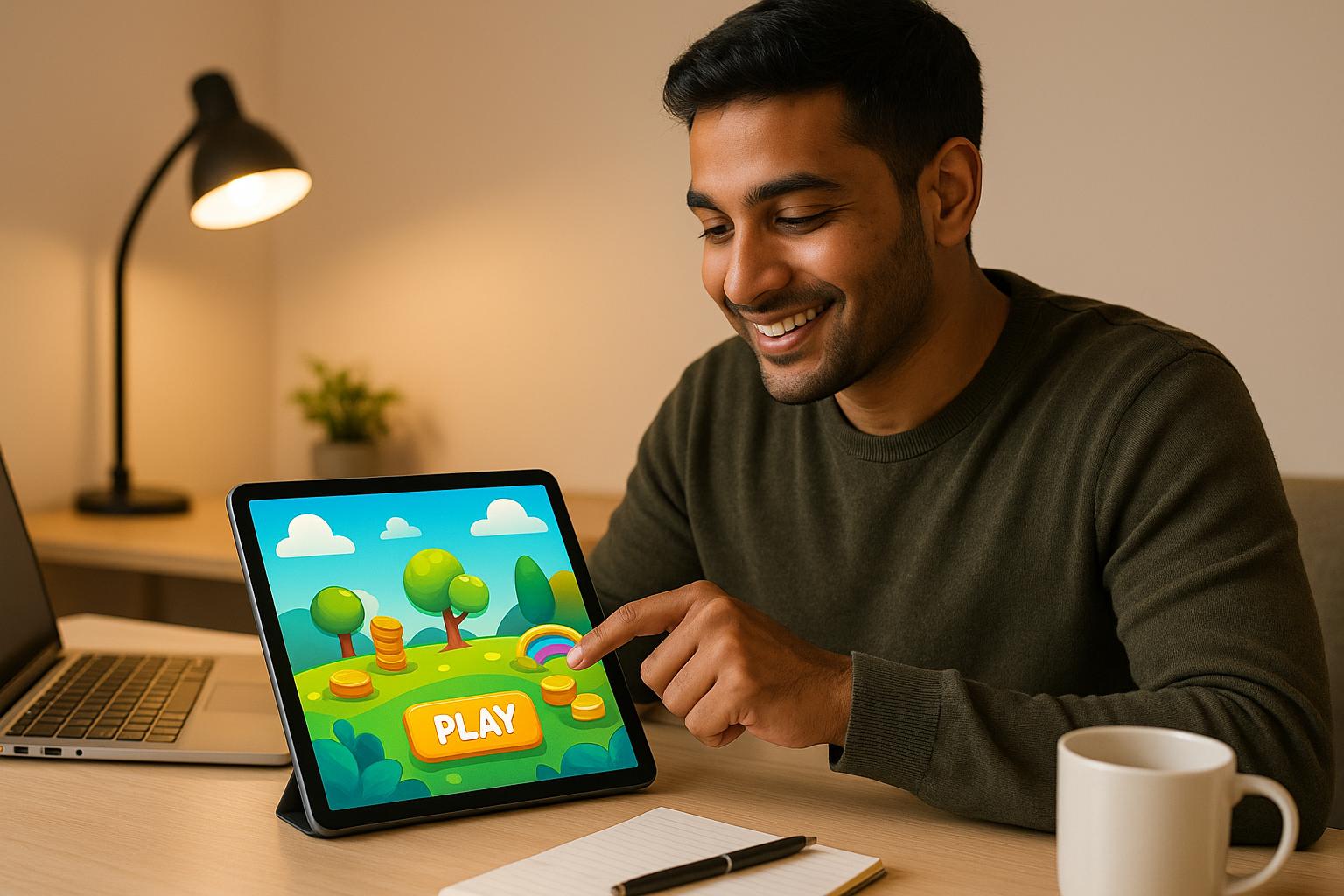
Playable ads outperform many traditional formats in driving user engagement and boosting CTR (click-through rate). Why? They allow users to interact with an app or game before committing, creating a more engaging experience. Here’s how you can optimize playable ads for better results:
- Focus on Interaction: Use simple, rewarding gameplay or app features to keep users engaged. Highlight key mechanics that showcase the app’s value.
- Keep It Short: Ads between 15–20 seconds perform best, achieving up to 15% higher CTRs compared to longer formats.
- Clear CTAs: Use bold, benefit-driven calls-to-action like “Play Now” or “Try It.” Ensure buttons are easy to tap and visually stand out.
- A/B Testing: Experiment with different hooks, designs, and CTAs to identify what resonates with your audience.
- Track Metrics: Monitor play-start rates, completion rates, and CTR to identify areas for improvement.
How to Win with Playable Ads – Alex Merutka, Craftsman+
How Playable Ads Work
Playable ads give users the chance to try out a mobile app or game before deciding to install it. Think of it like a test drive for apps – users can tap, swipe, or play through a short level to experience the app firsthand.
These ads are structured in three parts: a brief tutorial, a gameplay segment, and a call-to-action. Built using HTML5, they load quickly and work seamlessly across devices. This interactive format creates a more engaging experience for users compared to traditional ads.
Instead of passively watching or reading, playable ads let users interact directly with the app’s key features. This hands-on engagement often results in more qualified installs and better retention rates over time. On average, playable ads hold user attention for over 30 seconds, making them a powerful tool for deeper engagement.
What Makes Playable Ads Different
What truly sets playable ads apart is the active participation they require. Unlike banner, video, or interstitial ads that rely on passive consumption, playable ads demand interaction, which often leads to higher click-through rates (CTR).
Here’s a comparison of different ad formats:
| Ad Format | User Experience | Engagement Level | Primary Benefit |
|---|---|---|---|
| Playable Ads | Interactive demo with hands-on gameplay | High – users actively participate | Qualified installs and better retention |
| Banner Ads | Static or animated visual display | Low – passive viewing only | Brand awareness and broad reach |
| Video Ads | Short video clips showcasing features | Medium – watching without interaction | Visual storytelling and feature demonstration |
| Interstitial Ads | Full-screen static or video content | Medium – attention-grabbing yet possibly disruptive | Strong visual impact between content breaks |
Gamification is another unique element of playable ads. By rewarding users for achievements, these ads foster positive associations with the brand. A standout example is Burger King‘s 2015 campaign, which featured interactive gameplay and achieved 336,700 plays along with a 40.25% CTR in just 14 days.
Playable ads are also 32% more memorable than traditional formats. Even if users don’t install the app immediately, this strong recall can drive organic searches and downloads later on.
The Role of CTR in Playable Ad Success
CTR, or click-through rate, is a key metric for measuring the success of playable ads. It reflects genuine user interest, as it’s based on direct interaction with the ad.
Playable ads that offer meaningful interactions often see a 40% increase in CTR. Shorter ads, lasting 15–20 seconds, can further boost CTR by about 15% compared to longer formats. This combination of interactivity and brevity not only improves CTR but also enhances overall campaign performance.
What’s more, the clicks generated by playable ads tend to be of higher quality. Since users have already engaged with the app’s core features, their expectations align more closely with the app’s actual experience. This leads to stronger post-install metrics, including higher day-one retention and better in-app engagement.
Interactive ads also outperform traditional video ads in terms of conversion rates, sometimes achieving rates up to 700% higher. By analyzing which aspects of the ad resonate most with users, marketers can fine-tune their campaigns to drive even better results. Playable ads don’t just attract clicks – they bring in users who are genuinely interested and more likely to stick around.
Design Principles for Higher CTR
When it comes to playable ads, a well-thought-out design can make all the difference in boosting click-through rates (CTR). By prioritizing user-friendly interactions, precise timing, and compelling calls to action, you can create ads that truly resonate with your audience.
Create Meaningful User Interactions
At the core of any successful playable ad is its ability to engage users in a way that feels rewarding. People should feel like their actions within the ad matter.
To achieve this, use intuitive elements like swipe indicators, highlighted buttons, and clear instructions right at the start. These cues encourage users to dive in immediately. Incorporate simple, achievable challenges that provide quick wins and tease the app’s standout features. For instance, if you’re promoting a puzzle game, showcase its most satisfying mechanics. For a strategy game, highlight the decision-making aspects that make it fun. This ensures users have realistic expectations and are more likely to stay engaged after downloading.
Keep the design clean and focused. Limit the number of interactive elements on the start screen to two or three, and position them where users’ eyes naturally land. Avoid overwhelming them with too many options or excessive visual details.
Once you’ve captured their attention, it’s time to focus on timing to maintain interest.
Keep Ads Short and Focused
Playable ads work best when they grab attention quickly and stay concise. Aim to hook users within the first two seconds and keep the overall ad length between 10–25 seconds.
Shorter ads, particularly those in the 15–20 second range, tend to perform better, achieving up to 15% higher click-through rates compared to longer formats. Here’s a quick breakdown of how duration impacts engagement:
| Duration Range | User Engagement | Best Use Case |
|---|---|---|
| 10–15 seconds | High initial engagement | Quick, simple mechanics |
| 15–20 seconds | Optimal CTR performance | Focus on one core gameplay element |
| 20–25 seconds | Balanced experience | Showcasing multiple features or a mini-tutorial |
| 25–30 seconds | Risk of drop-off | More complex apps needing extra explanation |
Start strong by diving straight into the most exciting or challenging part of your app. If a user hasn’t interacted within 10 seconds, consider auto-playing the next scene to keep the momentum going. Instead of trying to cram in every feature, focus on one key mechanic that sparks curiosity and leaves them wanting more.
Once you’ve captured their interest, a well-placed call-to-action (CTA) can turn that interest into action.
Use Clear Call-to-Action Buttons
A well-designed CTA can significantly boost conversions – clear buttons outperform generic ones by 42%. For mobile ads, ensure your CTA buttons are at least 44×44 pixels to make them easy to tap.
Choose colors that contrast with the background while staying aligned with your brand. Also, consider accessibility for users with color vision deficiencies. As one design expert put it:
"High-converting CTAs leave zero room for ambiguity. They do not hint, they declare." – Design Studio
Use direct, benefit-driven copy for your CTA. Phrases like "Start My Adventure" or "Get My Power-Up" create a sense of ownership and urgency, making the action feel personal. Place the CTA where it naturally fits into the user journey – right after a challenge or an exciting moment. Interactive end cards, for example, outperform static ones by 47% in click-through rates.
To make your CTA even more engaging, add subtle animations that confirm the button is clickable without overwhelming the design. Testing different elements can also help refine your approach. For instance, a HubSpot experiment revealed that a red CTA button outperformed a green one by 21% because it stood out more. Try experimenting with colors, copy, placement, and animations to see what resonates best with your audience.
Finally, center your primary CTA on the end card for maximum visibility. Use concise text and clear imagery to ensure users immediately understand what action to take. By aligning your CTAs with the overall ad design, you can transform user interest into measurable results.
Testing and Automation Methods
Boosting CTR in playable ads hinges on effective testing and detailed tracking, ensuring every interaction is fine-tuned. The key lies in leveraging systematic testing and automation to elevate ad performance. Data-driven approaches can turn decent ads into highly effective ones.
Use Automation for Ad Production
Automation tools have reshaped how marketers create and scale playable ads. Instead of manually designing each version, these platforms allow you to generate multiple variations tailored to specific audience segments, devices, and placements – all while maintaining consistent quality.
These systems take your core playable ad concept and adjust it seamlessly for different screen sizes, operating systems, and user preferences. This means you can quickly test multiple versions without compromising creative integrity.
Start with a manually crafted ad that’s already performing well and use automation to tweak elements like visual themes, difficulty levels, or interactions. This approach builds on proven success rather than starting from scratch.
Device-specific adjustments are another critical consideration. What looks great on a tablet might not work as well on a smartphone. Automated tools can fine-tune touch targets, visuals, and timing for each device, saving you the manual effort. Once your variations are ready, focus on testing individual elements through A/B experiments to see what resonates most.
Run A/B Tests on Key Elements
A/B testing is one of the most efficient ways to improve performance. As Playable Factory puts it:
"A/B testing isn’t a ‘nice to have.’ It’s the cheapest performance boost you’ll ever buy." – Playable Factory
To get actionable insights, test one variable at a time. Experimenting with multiple changes simultaneously makes it hard to identify what’s driving better results. Start with the elements likely to have the biggest impact, such as your hook, visual layout, or call-to-action placement.
Before launching a test, outline clear objectives. Whether you aim to increase install rates, improve CTR, or reduce CPI, your goals will dictate which metrics to monitor and how long the test should run.
Randomly segment your audience to avoid bias, ensuring any performance differences are tied to the creative changes, not audience characteristics. Run both ad versions at the same time to eliminate timing-related variables like day-of-week effects or seasonal trends.
Take Towerlands, a mobile strategy game, as an example. In 2025, they tested different app icons. Their "yelling guy" icon, inspired by popular games, underperformed. On the other hand, an icon showing characters defending a tower resonated better with users, proving how aligning visuals with gameplay themes can drive better outcomes.
Always validate your findings using statistical significance. Avoid drawing conclusions from small sample sizes or short testing periods; reliable data takes time to gather.
Track Metrics for Ongoing Optimization
Once testing and automation are in place, tracking key metrics becomes essential for continuous improvement. Monitoring performance data helps identify what’s working and what needs adjustment. For example, if your interactive design is meant to grab attention, metrics like play-start and completion rates can confirm its effectiveness.
| KPI | Why it matters |
|---|---|
| Play-Start Rate (PSR) | Indicates if the creative hooks users effectively. |
| Playable Completion | Highlights friction points and pacing issues. |
| CTR to Store | A key predictor for CPI performance. |
| CVR / ROAS | The ultimate metric for financial success. |
Engagement metrics, such as play-start and completion rates, reveal how well your ad captures and holds attention. If users aren’t starting the experience, your hook might need tweaking. If they drop off halfway, consider adjusting the pacing or difficulty.
Post-install behavior is equally important. Metrics like retention rates, session length, and in-app purchases reveal whether your ad is attracting engaged users or just curious clickers. This data can guide adjustments to targeting and creative elements, ensuring you attract high-quality users.
Ad fatigue is another factor to watch. Keep an eye on frequency metrics and refresh your creatives as needed to maintain user interest.
One success story comes from Playturbo’s collaboration with Homer City by Mynet in February 2025. By using interactive end cards and closely tracking metrics, they boosted conversion rates by 69%.
Another valuable metric is click-to-conversion time, which sheds light on user intent and decision-making speed. A shorter conversion time often signals strong initial interest, while longer times may indicate the need for a clearer value proposition.
Set up automated dashboards to track daily trends and make quick adjustments. Use these insights to refine your strategy continuously and stay ahead of the curve.
sbb-itb-9ef3630
Advanced CTR Optimization Techniques
Once you’ve fine-tuned the basics of your ads, it’s time to dive into more advanced strategies to push your click-through rates (CTR) even higher. By combining insights from psychology, technical know-how, and AI-driven tools, you can craft ads that not only grab attention but also encourage meaningful interactions.
Add Reward-Based Elements
Incorporating rewards into your ads can significantly boost engagement. By offering users something of value in exchange for their attention, you create a mutually beneficial experience that drives better results.
"Rewarded video has the most profound effect on retention of any ad type. 30-day retention steadily increases with each video view, ranging from 53% to 68%, which is 3.5-5 times greater than the benchmark."
– ironSource, 2021 study
Here’s why reward-based ads work so well:
- Preference for choice: Four out of five mobile gamers prefer opt-in rewarded video ads over mandatory ones.
- Better ROI: Rewarded playable ads reduce cost per install (CPI) by 37% and boost return on ad spend (ROAS) by 2.5% compared to non-rewarded formats.
- Increased spending: Users interacting with rewarded ads are 4.5 times more likely to make in-app purchases.
- Influence on adoption: 84% of mobile gamers are more likely to try a new game when rewards are offered.
A 2020 survey by Zynga found that two-thirds of respondents were happy to trade in-game ad interactions for rewards, with 32% favoring playable ads over other formats. As a Zynga representative put it:
"Our players are willing to trade attention for rewards, preferring both rewarded video and our custom playables over other ad experiences."
– Representative from Zynga
To make this strategy work, focus on rewards that align with your app’s ecosystem. Whether it’s in-game currency, exclusive content, or extra lives, the key is to offer something that feels immediately valuable to your audience.
Next, ensure your ads perform consistently across all platforms.
Ensure Cross-Platform Performance
For ads to achieve their full potential, they must work seamlessly across all devices. A playable ad that performs well on one platform but stumbles on another can hold back your campaign’s reach. Using technologies like HTML5 can help ensure compatibility without requiring additional downloads.
Research reveals that users spend up to 47% more time engaging with playable ads compared to traditional formats, and these ads are 32% more likely to be remembered. However, these benefits only come to life when the ad functions smoothly on every device.
To ensure cross-platform success:
- Follow each platform’s technical guidelines meticulously.
- Design lightweight, fast-loading ads that adapt to different screen sizes and resolutions.
- Use responsive design principles to maintain consistent functionality across devices.
For example, in early 2025, Australian fintech company Lendi used a playable refinance calculator in a Facebook campaign. The result? A 20% increase in incremental leads and a 66% drop in cost per lead. This success underscores the importance of testing ads thoroughly across devices and browsers to ensure optimal performance.
Once you’ve nailed technical consistency, take it a step further by leveraging AI for personalized ad optimization.
Apply AI-Powered Optimization
Artificial intelligence is a game-changer when it comes to creating personalized, real-time ad experiences that drive higher CTR. By analyzing massive datasets, AI can uncover patterns in user behavior, preferences, and trends, allowing you to tailor ads to individual interests.
"By combining AI-powered Search ads products, you can create ads that adapt to show more relevant messages to more people while meeting your ROI goals. Google uses AI to set the right bids, reach the right searches, and create the most relevant ad for consumers."
– Google Ads Help
Here’s how AI can elevate your campaigns:
- Predictive analytics: AI can forecast user behavior, helping identify which creative elements are most likely to resonate.
- Targeting high-value users: Companies like Nexon use AI to pinpoint and acquire gamers who are likely to stay engaged and make in-app purchases early on.
- Optimized testing: AI excels at running multivariate tests, experimenting with creative elements, timing, and targeting to find the best combinations for different audiences.
- Continuous improvement: AI doesn’t stop at analysis – it actively adjusts bids, creatives, and targeting in real-time to enhance performance.
For mobile advertisers, blending creative strategies with AI-driven insights is the key to unlocking the full potential of their campaigns in today’s fast-evolving ad landscape. By implementing these advanced techniques, you can craft ads that not only stand out but also deliver results.
Conclusion: Building Long-Term CTR Success
Boosting CTR in playable ads demands a well-rounded strategy that combines creative brilliance with advanced technology. By 2024, the global daily volume of playable ad creatives hit 30,700, making up 8.3% of all mobile game ad creatives.
"Playable ads are the best performing ad unit with higher engagement rates, IPM and ROAS when used right."
– Playable Factory
This holistic approach delivers tangible results. The key lies in recognizing how data, design, and simplicity work together to create standout ad experiences. Even a minor 0.5-second delay can lead to an 18% drop in engagement, highlighting just how critical optimization is.
Winning campaigns often refresh creatives monthly and rely on A/B testing to fine-tune elements like difficulty levels and conversion triggers. For example, strategically placing call-to-action buttons alongside victory popups can boost conversions by 41%, while introducing forced-fail points has been shown to increase conversions by 63%.
As the industry evolves, technologies like augmented reality and virtual reality are set to make playable ads even more captivating. At the same time, advancements in AI and data analytics will enable hyper-personalized experiences tailored to individual user behaviors. Companies like Playrix have already showcased this potential – ads for their game "Homescapes" have driven higher engagement, increased downloads, and improved both user quality and revenue.
To prepare for the future, focus on building a strong foundation today. Prioritize the first three seconds of your ad, maintain visual consistency with your game’s design, and ensure fast load times – these steps are essential for taking advantage of upcoming innovations. Playable ad success is a continuous journey, with each campaign offering fresh insights into your audience. By systematically implementing these strategies, rigorously measuring results, and staying open to technological advancements, you can create campaigns that truly stand out. For more ideas on cutting-edge mobile ad strategies, visit Abhilash Krishnan – Creative AdTech Strategist.
FAQs
What mistakes should I avoid to boost CTR in playable ads?
To boost your click-through rates (CTR) with playable ads, steer clear of these common mistakes:
- Weak visuals or unclear messaging: Your ad needs to grab attention with striking visuals and a clear, engaging message that resonates instantly.
- Dull calls-to-action (CTAs): Use bold, direct CTAs that inspire users to take action right away.
- Ignoring user experience: Slow-loading ads or designs that clash with platform requirements can frustrate users and hurt performance.
- Content that doesn’t align: Ensure the ad’s theme and message are consistent with both the landing page and the interests of your target audience.
On top of that, make it a habit to test different ad variations to figure out what connects best with your audience. And avoid directly competing with the top apps in your category – it’s better to carve out your own space. A user-first strategy can make a big difference in improving CTR and driving better results for your campaign.
What’s the best way to use A/B testing to boost CTR in playable ads?
How to Use A/B Testing to Improve CTR in Playable Ads
If you want to improve the click-through rate (CTR) of your playable ads, A/B testing is a powerful tool. Start by defining specific goals – what exactly do you want to achieve? Whether it’s boosting engagement or driving clicks, having a clear objective will guide your testing process.
Next, pinpoint the elements you want to test. These could include gameplay mechanics, visual design, or even the reward structures within your ad. Create different versions of the ad, making sure each one tweaks a single variable for accurate comparisons. Then, run your A/B tests to measure how each version performs.
Pay close attention to metrics like engagement rates and CTR. These numbers will help you figure out which version resonates most with your audience. Once you identify a winning variation, use that insight to fine-tune your playable ads further. Keep testing and refining regularly to stay in sync with your audience’s preferences and campaign goals.
How does AI improve the performance of playable ads, and how can advertisers use it effectively?
AI has become a game-changer for playable ads, enhancing their effectiveness through real-time adjustments, personalized experiences, and automated creative processes. With AI, advertisers can quickly test multiple ad variations, customize content for individual users, and simplify the creative workflow, all aimed at boosting engagement and driving conversions.
To make the most of AI, advertisers can leverage data-driven algorithms to study user behavior, fine-tune ad components, and deliver highly specific content. This approach helps create ads that connect better with audiences, improving click-through rates (CTR) and overall campaign performance.