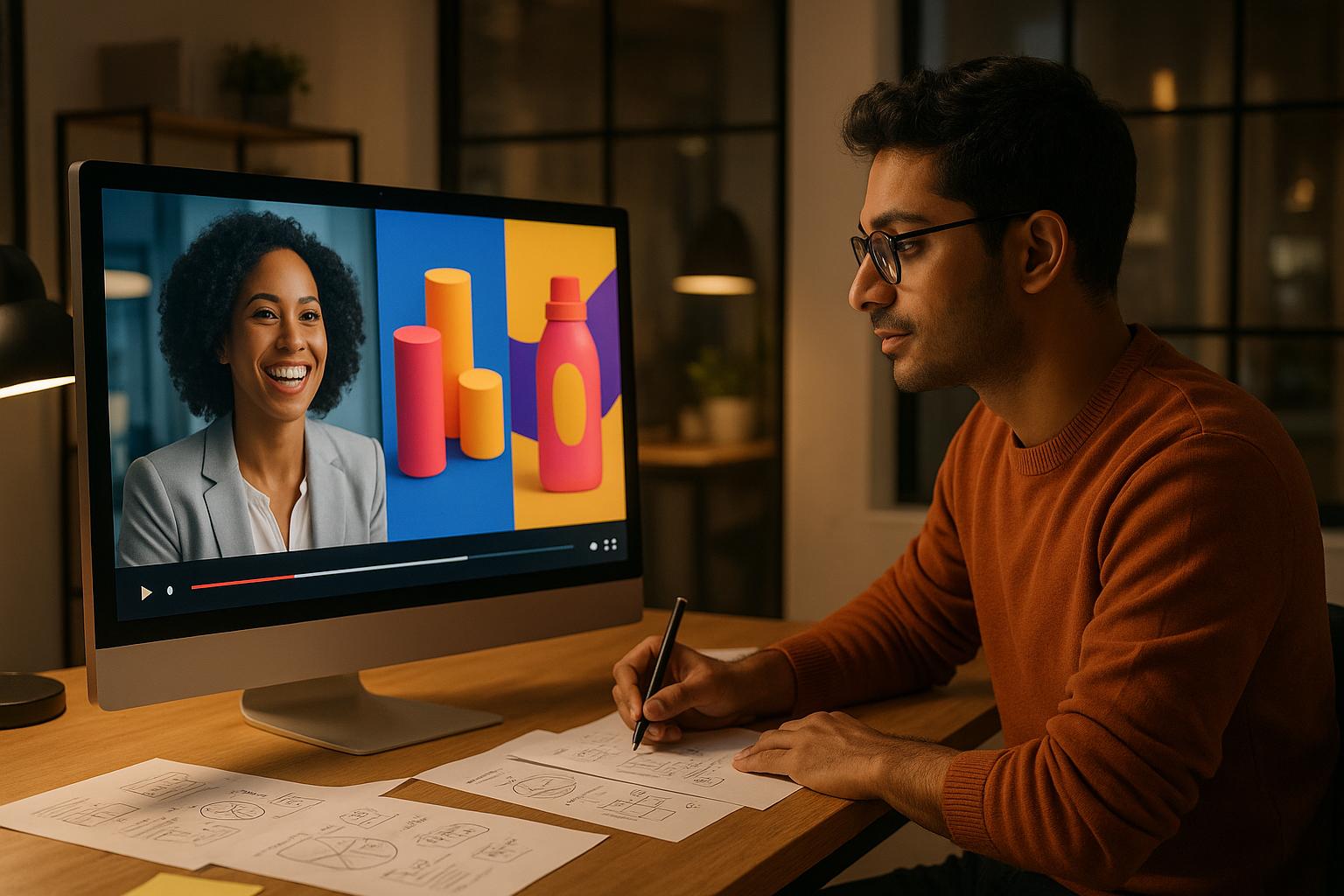
Generative AI is transforming video advertising by making it faster, more efficient, and accessible to businesses of all sizes. Here’s what you need to know:
- Automated Video Creation: AI tools can generate professional-quality ads quickly, handling visuals, voiceovers, and music with minimal input.
- Personalized Ads: AI enables tailored ad versions for specific audience segments, improving relevance and engagement.
- Multi-Platform Optimization: Create one video and let AI adapt it for different platforms like YouTube, Instagram, or TikTok.
- Cost Savings: Small businesses can now produce high-quality ads without large budgets, leveling the playing field.
- Real-Time Optimization: AI analyzes performance data to refine ads dynamically, ensuring better results.
Generative AI bridges the gap between efficiency and customization, offering brands tools to create impactful campaigns while reducing costs and timelines.
Next-Level AI Ads: Tips, Tricks & Full Workflow (VEO 3 + ChatGPT)
Automated Video Ad Creation
Generative AI is transforming the way video ads are created, making the process faster and more efficient than ever before. What once required extensive planning, shooting, and editing can now be streamlined with AI tools that turn ideas into professional-quality advertisements in a fraction of the time. These tools can handle everything from generating visuals and animations to adding voiceovers and music, automating tasks that traditionally required significant manual effort.
By analyzing prompts, brand assets, or even simple text descriptions, AI can create fully realized video ads. It can produce original footage, enhance existing content, or blend elements in imaginative ways – all without the need for heavy human intervention. This technology not only speeds up production but also introduces new levels of creativity, enabling brands to experiment and iterate quickly based on performance feedback.
Tools for Automated Ad Creation
A growing number of platforms now offer automated solutions for video ad creation, showcasing how this technology is reshaping creative workflows. These tools use advanced machine learning to generate content that aligns with brand guidelines while maintaining high quality. They can work with minimal input, producing ads that meet technical requirements like aspect ratios, file formats, and time limits. Many of these platforms also excel at creating narrative-driven ads, reducing the need for extensive manual effort.
Benefits for Brands of All Sizes
Automated video ad creation is making video advertising accessible to businesses of every size. For small businesses, it removes the barrier of high production costs, enabling even a local café to create ads highlighting menu specials, seasonal deals, or customer stories.
Mid-sized companies can use these tools to scale their creative output, crafting tailored ads for different audiences and platforms while staying true to their brand identity. Meanwhile, large enterprises can rely on automation to handle high-volume creative demands, allowing their teams to focus more on strategic planning and innovation rather than repetitive production tasks.
Beyond accessibility, these solutions also cut production costs and significantly reduce turnaround times compared to traditional methods. This efficiency allows brands to shift resources toward media buying and performance analysis, ensuring their campaigns not only look great but also deliver results.
Personalized and Audience-Specific Ad Versions
Generative AI is taking ad creation to a whole new level by enabling brands to produce personalized ad variations for specific audience segments. Instead of relying on a one-size-fits-all approach, AI can create dozens – or even hundreds – of tailored versions based on demographics, geographic regions, or user behavior.
This isn’t just about swapping out logos or tweaking text. AI can reimagine entire ads by adjusting visual storytelling, tone, imagery, pacing, and even music to better align with audience preferences. For instance, a fashion brand could create multiple ad versions showcasing different models, styling choices, or product combinations. These variations could target viewers based on age, location, or shopping habits, ensuring the content feels more relevant and engaging.
AI achieves this by analyzing audience data alongside brand guidelines to determine what elements should change for each group. For example, a younger audience might see ads with vibrant urban visuals and fast-paced editing, while a luxury-focused audience could experience slower, more polished narratives. This level of customization, once unimaginable at scale, is now within reach.
Dynamic Creative Optimization
AI doesn’t stop at creating tailored content – it also refines ads in real time through Dynamic Creative Optimization (DCO). This approach continuously tweaks creative elements based on performance data, learning what works best for different audiences. Instead of relying on static ad versions, DCO systems analyze metrics like click-through rates, engagement time, and conversions to identify high-performing elements. AI then uses these insights to generate new, optimized combinations.
This method is particularly effective for mobile advertising, where viewing habits can vary widely. For instance, AI might produce shorter, attention-grabbing ads for users scrolling during their morning commute, while crafting longer, more detailed versions for those browsing in the evening. It can also adapt content to match device capabilities, ensuring smooth playback on a variety of smartphones and tablets.
Scalability and Regional Targeting
Generative AI also shines when it comes to scaling ad campaigns for regional and local audiences. By incorporating regional nuances, AI ensures ads resonate with local viewers while staying true to the brand’s identity. It can seamlessly integrate elements like regional landmarks, local traditions, seasonal themes, and even language variations into video ads – without the need for separate production shoots.
For businesses with multiple locations, such as restaurant chains or retailers, this capability is a game-changer. A coffee chain, for example, could create location-specific ads featuring local store imagery, weather conditions, or promotions tailored to the area. From a single campaign concept, AI can generate countless variations that feel personalized and relevant to each region.
This scalability also extends to international markets. AI can adapt ads to align with cultural preferences, tweak color schemes to match regional aesthetics, and adjust pacing to suit different viewing habits. The result? A cohesive global brand presence that still delivers content with a local touch, making it feel authentic and relatable to audiences around the world.
Workflow Automation for Multi-Platform Video Ads
Running video ad campaigns across multiple platforms has always been a tricky process. Each platform – whether it’s Instagram Stories, YouTube, TikTok, or connected TV – has its own requirements for formats, aspect ratios, and content styles. Generative AI is stepping in to simplify this by automating the adaptation process. Brands can now create one master video and let AI generate platform-specific versions, optimized for each channel.
This automation goes beyond simple resizing or cropping. AI evaluates each platform’s technical specs and audience preferences to make smart adjustments. It can reframe shots, tweak pacing to match audience behavior, and even modify visuals to suit the viewing habits of a particular platform. For instance, a 30-second horizontal video designed for YouTube can be transformed into a 15-second vertical clip for Instagram Stories, complete with repositioned text overlays and adjusted visual focus points. This streamlined process ensures each version feels tailor-made for its platform while staying true to the original creative vision.
Mobile-First Strategy Automation
Mobile advertising presents unique challenges, but generative AI is built to handle them. It understands that mobile users interact with content differently – often in portrait mode, with the sound off, and during fleeting moments of attention. AI automatically creates mobile-friendly versions, emphasizing visual storytelling, adding captions, and structuring content to grab attention quickly.
This approach aligns perfectly with the growing trend of mobile-first advertising, where campaigns are designed primarily with mobile users in mind and then adjusted for other platforms. AI ensures these mobile-optimized versions are crafted to suit various networks and devices seamlessly.
AI also tackles cross-device consistency, ensuring users experience a unified campaign regardless of the device they’re using. For example, a user might see a short, snappy version of an ad on their phone during a commute, then encounter a more detailed version on their tablet at home. Both versions feel connected, sharing the same core message while adapting to the viewing context. This balance between customization and brand integrity is key in today’s mobile-driven world.
Consistency Across Platforms
Generative AI also ensures that campaigns maintain a consistent brand voice across all platforms, despite their differing requirements. One of the biggest hurdles in multi-platform advertising is balancing brand consistency with the need to adapt content for each platform. AI addresses this by keeping core brand elements – like logos, taglines, and signature colors – consistent across all formats, while allowing non-essential elements to adjust as needed.
This technology doesn’t just stop at visuals. It also adapts messaging to fit each platform while preserving the overall meaning. For instance, a detailed product explanation that works well on YouTube might be transformed into a series of quick, engaging visual highlights for TikTok. The key message remains intact, ensuring that users receive a cohesive experience, no matter where they encounter the campaign.
AI’s optimization doesn’t happen in a vacuum – it’s guided by performance data and platform-specific best practices. By learning from previous campaigns, AI identifies what resonates most with specific audiences. For example, brighter visuals might perform better on Instagram, while a more subdued palette could be ideal for LinkedIn. These insights are automatically applied to future campaigns, helping brands continuously refine their strategies while keeping their messaging consistent across all platforms.
sbb-itb-9ef3630
Content Ideas and Rapid Prototyping
AI is revolutionizing the way creative teams approach ad development, especially when it comes to generating ideas and building prototypes. What once took weeks – like crafting video ads – can now be done in mere hours. Generative AI has stepped in to simplify ideation and remove the common bottlenecks that slow down creative processes. Teams can now whip up multiple concepts, mockups, and even script drafts faster than ever before.
This is a game-changer for agencies and brands working with tight deadlines or limited budgets. With AI, a single brief can produce a variety of creative concepts, opening up possibilities that might not have been considered otherwise. It doesn’t replace human creativity but complements it, offering a solid starting point that creative professionals can refine and elevate.
AI prototyping also allows teams to test ideas before committing significant resources. This means fewer costly revisions and more confidence when choosing a final direction. Instead of presenting abstract ideas, teams can showcase fully visualized concepts to clients, leading to clearer feedback and quicker approvals. This streamlined approach sets the stage for AI-driven tools like storyboarding, which further accelerate the creative process.
AI-Powered Storyboarding Tools
Storyboarding has always been a time-intensive process, but AI is changing the game. Tools like Runway ML and Adobe Firefly can now generate visual frames from simple text prompts. For example, a creative director could type, "close-up of hands holding a smartphone with an app interface visible", and instantly receive multiple visual interpretations. No illustration skills? No problem.
These tools are designed to understand cinematic principles. They create frames that follow proper shot progression, maintain visual continuity, and suggest camera angles that enhance storytelling. This is especially useful for smaller teams or agencies that don’t have a dedicated storyboard artist on staff.
One of the standout features of these tools is their ability to rapidly iterate. Need to see how a scene looks with different lighting, settings, or character placements? AI can generate variations in seconds. This flexibility makes client presentations more dynamic and collaborative, as teams can explore different visual approaches on the spot. Many teams report that this early visual clarity reduces miscommunication and cuts down revision cycles later in production. Once the visual ideas are in place, teams can focus on refining their concepts to perfection.
Faster Concept Development
AI has dramatically sped up the timeline for concept development. Tasks that used to take days – like drafting scripts, brainstorming visual themes, or selecting music and pacing – can now be accomplished in just hours. This speed is particularly useful in reactive marketing, where brands need to respond quickly to trending topics or cultural moments. With AI, creative teams can brainstorm, test, and move to production while the topic is still relevant.
Another benefit is the ability to explore multiple concepts simultaneously. Instead of focusing on one idea at a time, AI enables teams to develop several creative directions at once. This not only increases the chances of discovering a standout idea but also provides backup options if a primary concept hits a roadblock. By reducing the pressure to rely on a single concept, teams often find themselves thinking more freely and creatively.
AI also helps by analyzing patterns in successful campaigns and using those insights to inform new ideas. For instance, it can identify what made a past video ad resonate with audiences and suggest similar strategies for new projects. This doesn’t lead to cookie-cutter results; instead, it provides a proven framework that teams can adapt to fit their brand and audience. It’s like having a creative assistant that blends data-driven insights with the flexibility to customize and innovate.
Cost Reduction and Accessible Ad Production
Generative AI has reshaped the landscape of video ad production by drastically cutting costs. This shift means even small brands can now produce professional-quality video ads without breaking the bank. What was once a space dominated by larger companies with hefty budgets has become more inclusive, leveling the playing field for small businesses, startups, and mid-sized companies. The financial hurdles that once stood in the way of these businesses have been removed, opening up new opportunities for creativity and storytelling. This cost-saving approach ties in perfectly with the streamlined ad creation processes previously discussed.
With AI handling tasks like generating visuals, animations, voiceovers, and music, local businesses can now produce content that meets industry standards at a fraction of the cost. These AI-driven workflows not only reduce expenses but also speed up production timelines, enabling brands to respond to market trends almost instantly.
Low-Budget Campaign Creation
The affordability of AI tools has empowered smaller brands to make a big impact with their video campaigns. Small and medium-sized businesses can now design compelling promotional content – like product demos, behind-the-scenes videos, or advertisements – without the need for expensive production crews. The focus has shifted from high production budgets to the strength of the messaging and creative ideas. In many cases, it’s the originality and relevance of the content that drive success, not the price tag attached to its creation.
Economic Changes in Ad Production
AI’s influence on ad production goes beyond just cost and speed – it’s changing the entire economic structure of the industry. Traditional production houses are adopting AI tools, while newer, AI-focused companies are entering the market with competitive pricing and faster delivery times. With the technical barriers lowered, brands are putting more emphasis on strategic planning, creative direction, and optimizing content for their target audiences.
Another game-changer? Brands can now test multiple creative concepts at once, quickly identifying what resonates most with their audience. This ability to experiment and adapt in real time is helping businesses keep their campaigns fresh and their audiences engaged.
Generative AI vs. Standard Video Ad Production
Deciding between generative AI and traditional video production comes down to your brand’s specific needs, budget, and long-term vision. Both approaches have their strengths and challenges, making the choice highly situational.
Traditional production relies heavily on human creativity and intuition. It captures spontaneous moments, genuine emotions, and perfect lighting to create content that feels personal and real. Plus, it operates within clear legal boundaries, offering more straightforward rules around intellectual property, data usage, and liability.
On the other hand, generative AI is all about speed and scalability. It allows brands to churn out multiple ad variations quickly, test creative ideas simultaneously, and customize content for different audience segments with minimal effort. This level of efficiency can be a game-changer for brands looking to experiment and adapt rapidly.
But generative AI isn’t without its risks. For instance, cases of deepfake content surged by 1,530% in the Asia-Pacific region between 2022 and 2023, raising concerns about trust and authenticity. AI models can also carry biases from their training data, leading to outputs that might unintentionally discriminate or misrepresent. Moreover, the technology often functions like a "black box", making it hard to understand how decisions are made.
Legal challenges further complicate the use of generative AI. Issues like copyright infringement, lack of protection for AI-generated outputs, and potential breaches of confidentiality are ongoing concerns. Traditional video production, by contrast, operates within well-defined legal frameworks, offering brands more clarity and security.
Comparison Table
| Aspect | Generative AI | Traditional Video Production |
|---|---|---|
| Speed | Quick production and iterations | Longer, more time-intensive process |
| Scalability | Easily creates multiple ad variations | Limited by manual production steps |
| Authenticity | Risks artificial or deepfake-like content | Delivers genuine human emotions and nuances |
| Legal & Regulatory | Faces complex copyright and IP issues | Operates within established legal boundaries |
| Personalization | Dynamically customizes for audiences | Requires manual adjustments |
This comparison highlights the trade-offs between speed, scalability, and the authenticity of each approach. Generative AI offers efficiency and customization but comes with security risks, such as potential misuse of sensitive data and the creation of deceptively realistic but false content.
Conclusion
Generative AI is changing the game in video advertising by delivering speed, scalability, and tailored content, as seen in its ability to automate ad creation, enable personalized targeting, and streamline multi-platform workflows. However, it’s crucial to remember that AI should work alongside, not replace, creative strategy.
The real advantage comes when human insight steers AI’s rapid prototyping and personalization, especially in mobile-first campaigns where strategic creativity is the backbone of performance. Whether it’s automating content creation or optimizing for multiple formats, generative AI gives brands the tools to tell consistent stories efficiently. But the magic happens when human creativity ensures those stories resonate on a deeper level with audiences.
For agencies and brands navigating this shift, the priority should be creating systems that leverage AI’s efficiency without sacrificing the authentic storytelling that makes ads memorable. This means understanding how to integrate AI into existing workflows while preserving the human element that connects with viewers.
As Abhilash Krishnan highlights, blending creativity with AI-driven innovation can lead to campaigns that truly stand out.
The path forward is clear: combine the power of AI with a strong creative vision to craft campaigns that are not just efficient but also genuinely engaging.
FAQs
How does generative AI keep video ads authentic and prevent issues like bias or misuse of deepfakes?
Generative AI plays a crucial role in keeping video ads genuine by leveraging advanced tools to detect altered or fake content. These systems meticulously scan for inconsistencies in AI-generated media, flagging potential deepfakes to ensure the final product is reliable and trustworthy.
To address bias, AI models are trained on a broad range of datasets and are closely monitored to minimize unintended prejudices. On top of that, legal regulations and ethical standards guide the responsible use of generative AI in advertising. By blending cutting-edge technology with oversight and ethical considerations, brands can confidently create video ads that are both engaging and authentic.
What legal challenges should brands consider when using generative AI in video advertising?
When incorporating generative AI into video advertising, brands need to navigate several legal hurdles carefully. One major issue is copyright infringement, which can arise if AI-generated content mimics existing protected works without proper authorization. Another potential pitfall is violating rights of publicity – for instance, creating content that resembles real individuals without securing their consent.
Privacy laws add another layer of complexity. AI models often rely on training datasets that may include personal data, raising concerns about compliance with data protection regulations. On top of that, the lack of well-defined legal standards for AI-generated content can create uncertainty around intellectual property ownership and liability in case of disputes.
To address these challenges, it’s crucial to stay aligned with relevant laws and regulations. Additionally, establishing clear contractual terms when integrating AI into your processes can help reduce risks and provide clarity on responsibilities.
How can small businesses use generative AI to create affordable video ads that stand out against larger brands?
Small businesses now have the power to create engaging video ads with the help of generative AI – without breaking the bank. These AI-driven tools can produce personalized, audience-specific content in no time, making it easier for businesses to deliver ads that truly resonate, all while keeping costs low compared to traditional production methods.
Generative AI also simplifies the production process by automating tasks like scriptwriting, video editing, and even voiceovers. This not only saves time but also reduces expenses, allowing smaller brands to channel their energy into the creative aspects of their campaigns. With these tools, small businesses can produce professional-quality ads that hold their own against larger competitors. Plus, they can stretch their ad budgets further and see stronger results from their marketing efforts.