
AI is reshaping how advertisers measure engagement. Traditional metrics like clicks and impressions no longer reflect true ad performance. Instead, attention metrics – powered by AI – focus on signals like gaze fixation and interaction time, offering a clearer picture of user engagement. Here’s what you need to know:
- Attention Metrics vs. Traditional Metrics: While impressions and click-through rates (CTR) are basic, attention metrics dig deeper with data like time-in-view and scroll velocity.
- Why It Matters: Ads designed with attention in mind drive up to 20% more conversions and double recall rates compared to impression-based strategies.
- AI’s Role: Platforms like SmartyAds DSP and AppsFlyer use AI to track real-time attention signals, optimize campaigns, and improve ad targeting.
- Market Trends: 63% of brands are increasing investments in attention metrics, with tools like SmartyAds achieving 99% viewability and AppsFlyer holding 48.51% of the Android attribution market.
Key Takeaway: Attention metrics, powered by AI, are redefining ad success. They not only measure engagement but also improve ROI and campaign outcomes. Whether you’re a startup or a large enterprise, choosing the right platform depends on your goals, budget, and technical expertise.
Measuring What Matters: The Shift from Viewability to Attention in Ads | Below The Fold
1. SmartyAds DSP
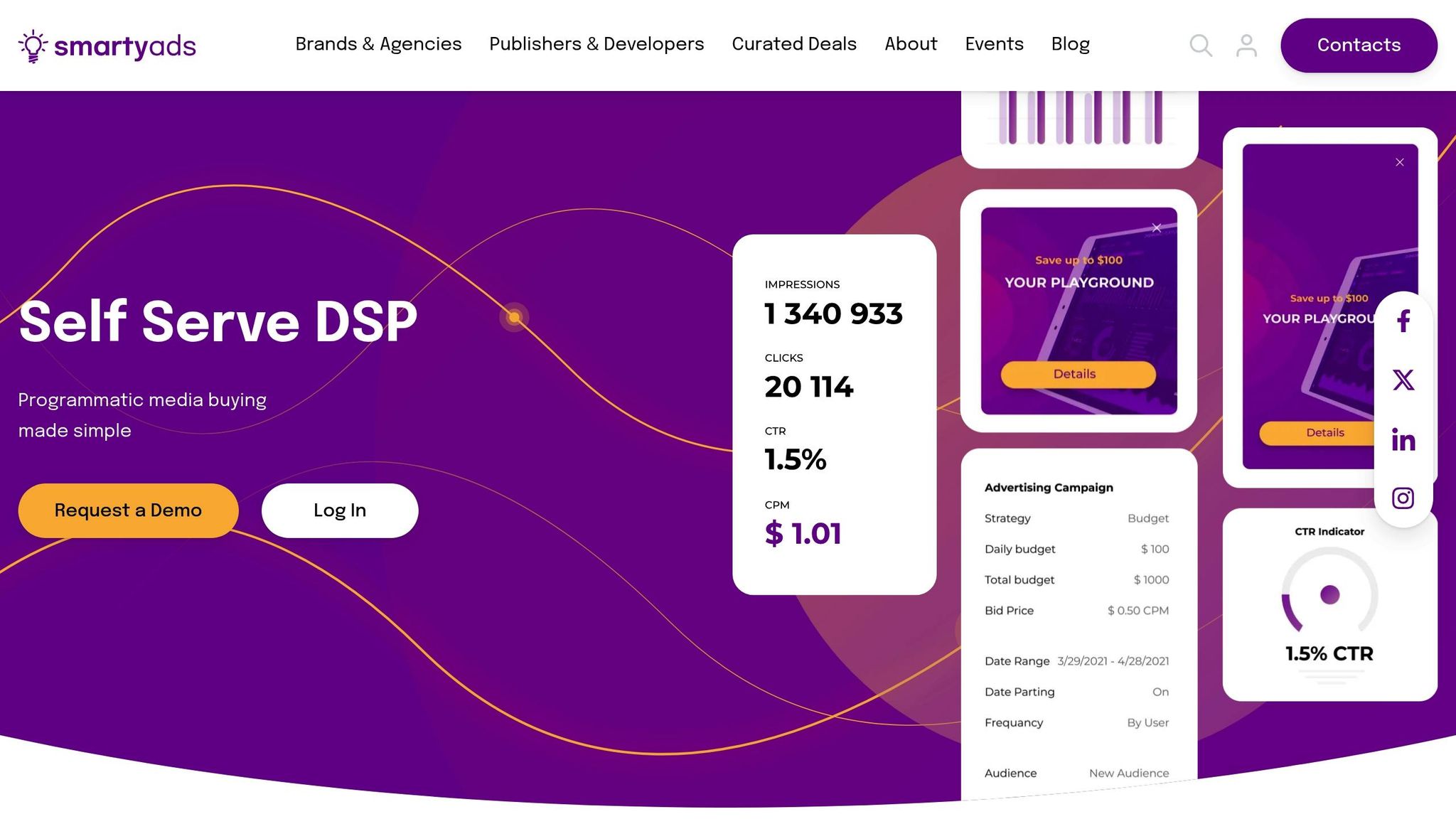
SmartyAds DSP is a programmatic advertising platform that prioritizes AI-driven attention measurement in its mobile advertising strategy. Instead of relying solely on traditional impression-based metrics, it focuses on whether users are actively engaging with your ads.
AI-Driven Attention Measurement
Using advanced AI and machine learning algorithms, SmartyAds DSP analyzes attention signals in real time. Metrics like time-in-view and engagement depth help determine if ads are genuinely resonating with users. The platform’s AI-powered bidding system optimizes ad placements based on these signals, ensuring your budget targets inventory that drives meaningful engagement.
"SmartyAds ensures media-buying efficiency through intelligent bid optimization AI and ML-based algorithms that analyze real-time data to maximize ROI. They dynamically adjust bids based on optimization and campaign goals, delivering better impressions at lower costs."
This focus on real-time attention signals enables ongoing improvements in campaign performance.
Real-Time Optimization
SmartyAds DSP continuously adjusts bids based on live performance data and campaign goals. With an average click-through rate (CTR) of 5.48% and a cost per thousand impressions (CPM) of about $1.01, it demonstrates the effectiveness of real-time optimization. Customizable reports offer detailed insights into metrics like impressions, clicks, spend, CTR, and win rate, empowering advertisers to make quick, informed decisions.
The platform’s mobile-first approach further enhances its ability to meet the demands of modern advertising.
Mobile-Specific Features
Mobile advertising requires a tailored approach, and SmartyAds DSP delivers with mobile-optimized ad formats such as rich media, playable ads, rewarded videos, and interstitial ads. These formats provide engaging content without disrupting the user experience. Additionally, its cross-device omnichannel delivery ensures that ads are well-suited for various devices within the mobile ecosystem. The platform also supports precise targeting options, including geolocation, language, age, gender, operating system, and device type.
SmartyAds DSP achieves a 99% viewability rate with built-in safety tools and serves an impressive 366,847 impressions daily. Its ad fraud detection solutions further enhance viewability, meeting strict industry standards.
"SmartyAds viewability metrics allow our clients to get insights regarding user engagement with different types of ads, viewership data, as well as identification of real human views. This way advertisers can discover which ad placements and audiences provide the most value to their business."
Creative Automation Capabilities
Campaign management is simplified with features designed to maximize performance. SmartyAds DSP offers adaptive CPM optimization, smart bidding, and click booster tools that automatically adjust to achieve optimal results. A unified dashboard provides a complete overview, enabling advertisers to monitor budgets, traffic, and campaign performance from one central location. This automation spans multiple ad formats – including banner, video, native, rich media, audio, and digital out-of-home (DOOH) – across devices like mobile, tablets, desktops, and TVs.
With a 4.7/5 rating on Capterra for user-friendliness, SmartyAds DSP is praised for its precise targeting, high-quality traffic, and strong support. However, some users have noted that its reporting capabilities could be expanded.
2. AppsFlyer
AppsFlyer stands out as a mobile attribution platform that focuses on refining campaign measurement specifically for mobile apps. Unlike traditional analytics tools that prioritize web data, AppsFlyer zeroes in on mobile app performance, offering detailed insights into user acquisition, retention, and engagement. This allows mobile-first companies to make smarter, data-driven decisions.
AI-Driven Attention Measurement
AppsFlyer uses AI to analyze creative assets and pinpoint which elements grab and hold user attention. Through advanced algorithms, the platform evaluates ad performance across campaigns and channels, identifying patterns that connect creative elements with user behavior and conversion rates. This kind of analysis goes beyond clicks, helping marketers understand what truly resonates with their audience.
"By delivering sophisticated, in-depth creative insights, it enables growth marketing teams to optimize spend, increase scale, and drive profitability by automatically identifying which creatives perform best in campaigns. Simultaneously, it equips the creative team with valuable insights on the attributes of winning creatives, empowering them to focus on the most effective elements and allocate their time and resources more efficiently." – Yevgeny Peres, EVP of Product Strategy at AppsFlyer
These insights can even be integrated into generative AI processes, allowing for the automatic refinement and scaling of creative strategies. This continuous analysis ensures campaigns stay adaptable and effective.
Real-Time Optimization
AppsFlyer’s AI operates around the clock, monitoring campaigns for anomalies in key metrics like CPI and ROAS. It visualizes data and provides natural language insights, making it easier for teams to understand performance trends. By studying historical data, the platform forecasts future outcomes and suggests adjustments to budgets and creative strategies. It also predicts which user segments are likely to deliver the highest lifetime value, recommending optimal bidding strategies to maximize returns.
For example, a direct-to-consumer fashion brand using AppsFlyer AI found that combining Instagram Story ads with email remarketing tripled their conversion rates compared to single-channel campaigns. In another case, the platform revealed that users who added items to wishlists within 48 hours of installing an app generated 65% more lifetime value than the average customer.
Mobile-Specific Features
Designed for the unique challenges of mobile advertising, AppsFlyer tracks the entire customer journey, from the first impression to purchase. This helps marketers better understand churn and lifetime value. As of March 2024, AppsFlyer holds a commanding 48.51% share of the Android app attribution market, solidifying its leadership in mobile analytics. The platform also includes robust fraud protection, using behavioral analysis to block fraudulent activity and ensure marketing budgets are spent on genuine user engagement. When iOS 14.5 privacy changes disrupted traditional attribution methods, AppsFlyer adapted by leveraging aggregated data analysis, maintaining over 90% accuracy in its models.
This mobile-first approach ensures campaigns focus on meaningful engagement rather than superficial metrics.
Creative Automation Capabilities
AppsFlyer’s Creative Optimization feature simplifies the management of creative assets by automatically importing data from campaigns run through its integrated partners. These integrations feed the system with metrics like cost, installs, clicks, retention, and lifetime value. The platform’s AI can identify duplicate creatives, even if they have different names, and allows users to set rules for tagging or manually organize assets. This automation makes it easier to test multiple creative variations – sometimes over 50 – to find the most effective ones.
In 2024, fintech company Dave used this feature to streamline their creative process, cutting tasks that previously took 8–10 hours down to a fraction of the time. Similarly, Papaya Gaming turned their creative marketing efforts into a growth engine for their award-winning games. Brands leveraging AppsFlyer’s AI-driven tools have reported a 200% boost in production success rates.
sbb-itb-9ef3630
3. Abhilash Krishnan – Creative AdTech Strategist
Abhilash Krishnan brings nearly two decades of expertise in AdTech, blending creativity with cutting-edge AI tools to deliver impactful results in mobile advertising.
Focusing on mobile-first strategies, Krishnan specializes in AI-driven creative automation frameworks. These frameworks empower brands and agencies to achieve standout campaign performance, combining innovation with measurable outcomes. His unique approach bridges the gap between technology and creativity, ensuring campaigns resonate with audiences while delivering strong metrics.
Krishnan advocates for a balanced use of advanced tools, such as augmented reality (AR) and generative AI, to enhance – not replace – human creativity. By offering consulting services, he helps creative teams tackle complex tech challenges, ensuring campaigns not only succeed but excel. His methods align with AI-driven optimization strategies, boosting attention metrics and driving meaningful engagement.
Platform Strengths and Weaknesses
AI-powered attention metrics bring a mix of benefits and challenges, with each platform offering distinct features that can influence campaign outcomes and ROI. The table below highlights the strengths and weaknesses of three prominent approaches.
| Platform | Key Strengths | Primary Weaknesses |
|---|---|---|
| SmartyAds DSP | • AI-driven bidding with real-time optimization • Heatmap integration for visual attention tracking • Customizable targeting models • Proven results, such as a 180% conversion boost for fintech clients |
• Requires technical expertise for setup • Steeper learning curve for beginners • Premium pricing for advanced features |
| AppsFlyer | • Comprehensive mobile attribution tracking • Strong revenue and conversion analytics • Established reputation in the market • Focus on user lifetime value optimization |
• Limited creative optimization tools • Primarily focused on attribution, not attention metrics • Less emphasis on real-time creative testing |
| Abhilash Krishnan’s Approach | • Combines human creativity with AI-powered efficiency • Built on 19+ years of industry experience • Custom frameworks tailored to brand needs • Strategic consulting for complex challenges |
• Requires direct engagement for implementation • Custom solutions may take longer to deploy • Higher upfront investment for personalized strategies |
SmartyAds DSP stands out for its measurable impact. For instance, one e-commerce brand managed to triple its ad spend while keeping its cost per acquisition steady, thanks to automated creative optimization. This aligns with broader trends showing that AI-driven advertising can improve conversion rates by up to 30%.
AppsFlyer excels in mobile attribution, making it a strong choice for brands focusing on long-term user value. However, its emphasis on attribution can be a drawback for advertisers who prioritize creative attention metrics over tracking.
Abhilash Krishnan’s approach takes a different route, blending human insight with AI efficiency. His method addresses a common industry challenge: low ad view rates. By integrating strategic creative testing with AI tools, this approach ensures brand consistency while leveraging advanced technologies for better results.
When it comes to costs and technical demands, each option has its trade-offs. Automated platforms like SmartyAds DSP are scalable but require programmatic expertise, while AppsFlyer demands a deep understanding of mobile attribution. On the other hand, consultative approaches, such as Abhilash Krishnan’s, offer tailored solutions but involve a higher initial investment and longer deployment timelines. These factors can significantly influence launch speed and overall campaign efficiency.
Ultimately, the right platform depends on your campaign goals and resources. Brands looking to scale often gravitate toward automated platforms, while those seeking to enhance creative strategies may benefit more from consultative solutions that balance technology with human creativity.
Conclusion
The world of AI-driven attention metrics is opening up new opportunities for mobile advertisers, offering tailored solutions based on campaign goals and budgets. With 63% of brands increasing their investments in attention-based strategies, selecting the right platform is more important than ever.
Budget plays a big role in choosing the right platform. Startups with monthly budgets under $5,000 often prioritize cost-effective tools, while mid-sized businesses ($5,000–$50,000) can take advantage of more advanced AI-driven options. Larger enterprises, on the other hand, need systems that are scalable and seamlessly integrated into their operations.
Each platform requires different levels of technical know-how. For example, SmartyAds DSP is ideal for those with programmatic expertise, delivering measurable results for its users. AppsFlyer, in contrast, offers a simpler route to mobile attribution. Meanwhile, experts like Abhilash Krishnan blend AI analytics with creative insights, providing a more customized and consultative approach.
The platform you choose should align with your campaign objectives. If optimizing campaigns through AI insights is your main focus, platforms with strong algorithmic capabilities are a smart choice. For brands prioritizing long-term user engagement and comprehensive mobile attribution, systems that integrate attention metrics into their processes are more effective. Companies aiming to merge creativity with AI-driven efficiency will benefit from platforms that combine human insight with advanced technology. These targeted strategies are shaping an industry-wide evolution.
This transformation highlights a crucial takeaway: attention metrics are redefining success in advertising.
"Attention metrics measure not just presence but presence with intention – a far cry from vanity metrics that merely confirm your ad technically existed on the page."
At the end of the day, the right platform balances cost, accuracy, and usability. Think about your team’s technical skills, the complexity of your campaigns, and your growth goals before making a decision. Many advertisers start with one platform to establish benchmarks and then scale as they gain insights and confidence.
FAQs
How do AI-powered attention metrics provide better insights into ad engagement than traditional metrics like clicks and impressions?
AI-powered attention metrics dive beneath the surface of user interactions, offering a richer view of engagement. Instead of just counting clicks or impressions, these metrics evaluate how actively users engage with ads. By analyzing factors like user behavior, context, and timing, they measure the depth of attention, giving advertisers a clearer picture of how well their ads connect with the audience.
Traditional metrics, like clicks and impressions, often fall short – they only show basic interactions and might not reflect genuine consumer interest. On the other hand, AI-driven attention metrics focus on active engagement, enabling advertisers to fine-tune their campaigns and drive stronger results.
How does SmartyAds DSP use AI to improve attention metrics in mobile advertising?
SmartyAds DSP uses AI-driven tools to improve how mobile ads grab and hold attention by optimizing performance and engagement. Some standout features include AI-powered bidding, which helps secure the best ad placements efficiently, and real-time heatmap analysis that monitors where users focus and interact. Plus, with customizable targeting models, advertisers can fine-tune their campaigns to connect with their audience more effectively and keep their attention where it matters most.
How does AppsFlyer use AI to enhance creative strategies and boost mobile app campaign performance?
AppsFlyer uses AI to fine-tune creative strategies by examining how different ad components – like videos, images, and text – perform. With their AI-driven tools, marketers can pinpoint which creatives work best, allocate ad budgets more effectively, and make smarter, data-backed decisions to enhance campaign results.
By combining AI insights with emotional metrics, AppsFlyer helps ensure campaigns connect with audiences on a deeper level, leading to stronger engagement and higher return on investment (ROI). These tools give marketers the edge they need to thrive in the fast-changing world of mobile advertising.