
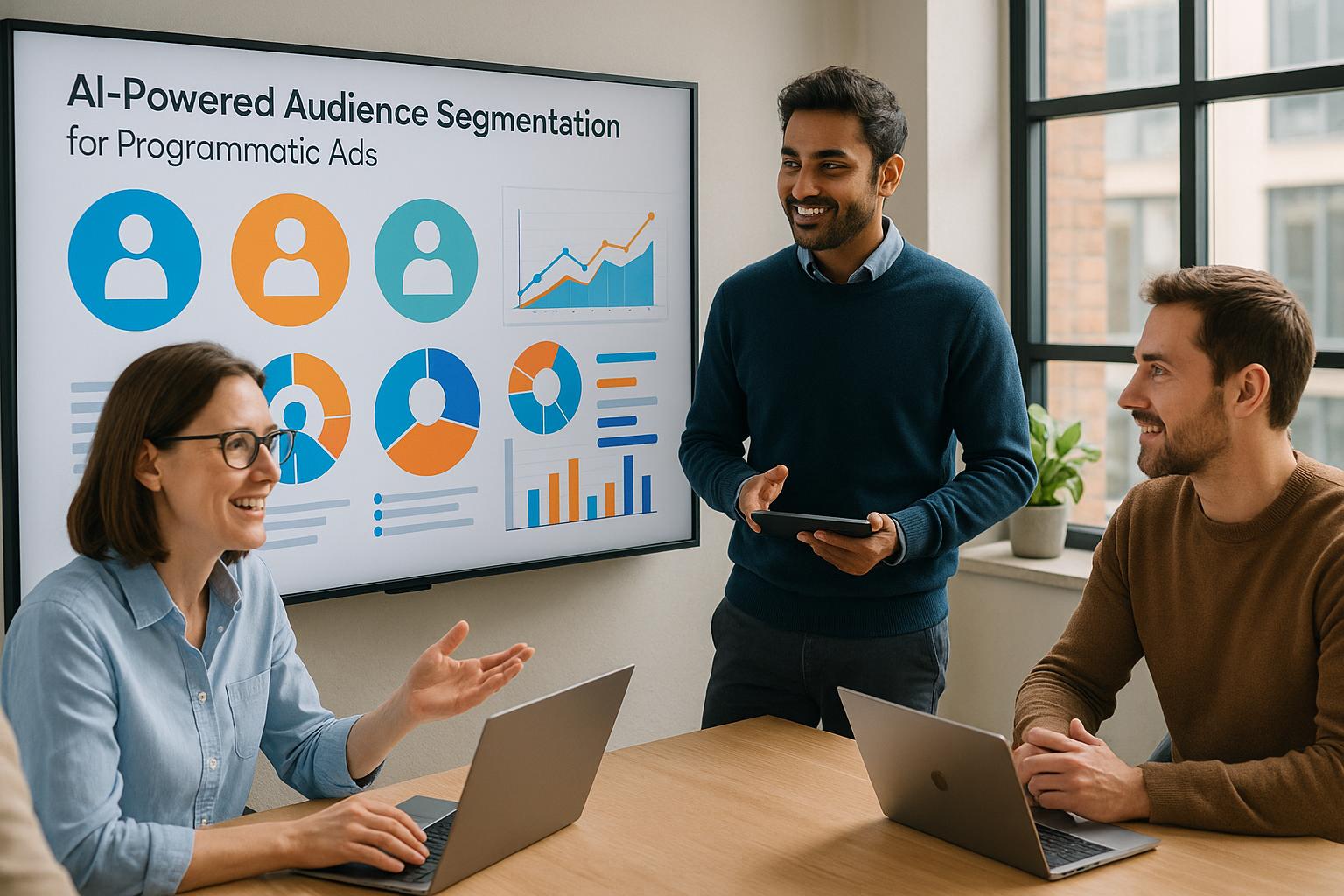
AI is transforming programmatic advertising. By analyzing real-time data like behavior, purchase history, and preferences, AI provides more precise audience targeting than traditional methods. Here’s why it matters:
- Higher Performance: AI boosts ad performance by 30% and cuts costs by 25%.
- Dynamic Segmentation: Unlike static methods, AI adjusts audience groups in real time for better relevance and results.
- Personalization: AI can target specific groups, such as eco-conscious shoppers, with tailored messages.
- Proven Results: Companies like Adidas and Sephora have seen conversion rates jump by 30% or more using AI.
AI-powered tools not only improve ROI but also reduce costs and save time. However, transparency and ethical practices are key to building trust with consumers. Ready to learn how to use AI for smarter advertising? Let’s dive in.
How to Build Customer Segments with AI (Real-World Use Case)
How AI Changes Audience Segmentation
AI is reshaping the way advertisers understand and categorize their audiences. Unlike traditional methods that rely on basic demographics like age or location, AI delves into deeper behavioral patterns that influence purchasing decisions. Previously, nearly half of marketers (49%) relied on guesswork to segment their audiences. Now, AI provides a level of data-driven precision that eliminates much of the uncertainty. This shift lays the groundwork for exploring behavioral insights in greater depth.
AI-Driven Behavioral Analysis
AI has an uncanny ability to spot subtle customer behavior patterns that might escape even the most experienced human analysts. From tracking browsing habits and intent signals to analyzing purchase frequency and sentiment, AI provides a comprehensive picture of consumer activity. But it doesn’t stop there – it also uncovers the "why" behind these actions. Predictive analytics, for instance, can forecast future behaviors based on current trends, while clustering algorithms group users by shared preferences and tendencies.
Take, for example, a fashion retailer that used AI to analyze style preferences across its customer base. This allowed them to create personalized email campaigns, resulting in a 35% increase in sales. Similarly, a tech company used AI to identify customers likely to upgrade their services, boosting their upsell rate by 20% through targeted outreach. AI’s strength lies in its ability to segment customers down to an individual level, enabling a scalable approach to personalization. This level of granularity allows advertisers to target highly specific micro-audiences with messages that resonate on a personal level.
These advanced capabilities make it possible to continuously refine audience segments, a hallmark of dynamic segmentation.
Dynamic vs. Static Segmentation
The difference between AI-powered dynamic segmentation and traditional static methods is like comparing a live video stream to a single snapshot. While static segmentation relies on fixed criteria that remain unchanged throughout a campaign, dynamic segmentation uses AI to adjust audience groups in real time based on behavioral data.
Here’s how the two methods stack up:
| Aspect | Static Segmentation | Dynamic Segmentation |
|---|---|---|
| Data Processing | Manual, slow analysis of basic criteria | Real-time processing of complex datasets |
| Adaptability | Fixed segments throughout a campaign | Continuously evolving based on new data |
| Personalization | Generic campaigns to entire segments | Real-time tailored messaging and offers |
| Pattern Detection | Limited to obvious correlations | Uncovers hidden behavioral patterns |
| Bias Factor | Prone to human error and assumptions | Reduces bias with data-driven insights |
Dynamic segmentation allows businesses to categorize audiences in real time, responding to changes in behavior, preferences, and interactions. This adaptability ensures that as customers shift their browsing habits or purchasing patterns, AI adjusts the audience segments and messaging accordingly. The result? Advertising stays relevant, even as customer interests evolve.
Amazon is a prime example of this approach. Its algorithms analyze past purchases, search history, and even the time spent viewing products to deliver timely, relevant recommendations.
The speed and efficiency of AI give it a clear edge. Traditional segmentation methods can take weeks – or even months – to analyze data and make adjustments. AI, on the other hand, processes information in real time, allowing businesses to respond instantly to shifts in customer behavior. Dynamic segmentation also ensures insights remain fresh and actionable, thanks to live analytics, custom reporting, thorough data cleaning, and advanced deep learning techniques – all while maintaining a privacy-first approach. The result? Better targeting and more effective campaigns.
Impact on Programmatic Advertising Performance
Organizations adopting AI-driven segmentation are seeing a game-changing boost in their advertising outcomes. On average, these companies report a 76% increase in ROI compared to traditional methods. This shift is redefining how digital advertising operates.
Better Campaign Performance
AI-powered segmentation is delivering impressive results across key advertising metrics. For example, integrating AI has been shown to improve conversion rates by 25% on average. Click-through rates (CTR) also see massive improvements, with AI campaigns achieving a 131% increase in CTR and a 41% boost in overall engagement. Personalized ads are particularly impactful, generating 6 times higher transaction rates. Campaigns that use AI-refined audience targeting experience an average 38% higher engagement rate.
Real-world success stories highlight the potential of AI in action:
- Adidas introduced AI-driven personalization in its ad strategies, leading to a 30% jump in conversion rates across digital campaigns.
- North Face utilized AI-powered personalization and predictive analytics to create tailored shopping experiences, resulting in a 60% increase in CTR.
- Sephora revolutionized its online shopping with AI, achieving a 30% rise in user engagement and an 11% boost in conversions.
Dynamic creative optimization (DCO) is another AI-powered tool driving results. DCO adjusts ad components like headlines, visuals, and calls-to-action in real time based on audience data. This approach has been shown to increase CTR by an astounding 257% compared to static creatives.
These advancements not only elevate campaign performance but also introduce meaningful cost efficiencies.
Lower Ad Spend Costs
The performance improvements driven by AI often come with reduced costs. On average, AI-optimized campaigns achieve a 30% reduction in customer acquisition costs across industries. For e-commerce advertisers, AI-driven bidding and budget allocation lead to a 28% higher return on ad spend (ROAS) compared to manual campaign management.
Some notable examples of cost savings include:
- Adore Me cut customer acquisition costs by 15–20% while increasing ROAS by 30% through AI-enhanced ad targeting and budget optimization.
- Toyota used AI to analyze consumer data and predict car-buying behavior, resulting in a 53% improvement in qualified leads and a 21% increase in dealership visits from digital advertising.
- Stitch Fix leveraged AI to analyze over 30 customer data points, which led to a 45% increase in first-time customer acquisitions and a 21% reduction in acquisition costs over a year.
Beyond cost reductions, AI also frees up time and resources. Marketing teams using AI automation tools save an average of 59% of the time previously spent on campaign management tasks. Additionally, AI plays a key role in combating programmatic ad fraud, which is projected to cost the industry $23 billion globally by 2025.
AI-optimized campaigns also last longer before experiencing creative fatigue, staying effective three times longer than traditional campaigns. This extends the lifespan of advertising assets and maximizes their value.
How to Implement AI-Powered Audience Segmentation
To make AI-powered audience segmentation work, you need clear goals and a structured approach. This typically involves gathering data, deciding on segmentation criteria, deploying AI tools, personalizing campaigns, and keeping an eye on performance metrics. Following this process can lead to better conversion rates and cost savings.
Companies that start with measurable goals tend to achieve more consistent results in their campaigns. Once objectives are set, the next step is leveraging your own data.
Using First-Party Data
First-party data is the cornerstone of effective AI segmentation. This data comes directly from your customers – through their activity on your website, purchase history, email interactions, and social media engagement. In fact, 72% of shoppers expect businesses to recognize them as individuals and understand their interests.
To maximize the potential of this data, centralize it. Combine CRM records, website analytics, email data, and social media insights into a single database. This consolidated view allows AI to uncover patterns that might go unnoticed otherwise.
For example, analyzing customer behavior – such as page visits, purchase history, or social media interactions – can reveal not only who your audience is but also how they engage with your brand. Some platforms even support automatic updates to audience segments, ensuring they remain relevant in real time. Imagine a customer who frequently browses premium products but hasn’t made a purchase yet. AI can move them from a general “browser” segment to a “high-intent prospect” segment based on their recent activity.
A great example of this in action is Starbucks. They encourage customers to share their data by offering rewards like discounts and exclusive products. This approach not only drives repeat purchases but also provides insights into buying habits. Using AI to analyze this data, Starbucks has seen conversion rates soar by 500% and click-through rates increase by 300%.
Real-Time Campaign Adjustments
One of AI’s standout features is its ability to process data instantly, allowing for real-time campaign adjustments. As customer behaviors evolve or market conditions change, AI can automatically tweak audience segments and campaign settings without any manual effort.
AI constantly analyzes incoming data, updating segments to seize new opportunities. For instance, if it notices a particular demographic engaging more with specific ad formats during certain hours, it can adjust bidding strategies or creative delivery to capitalize on that trend.
Machine learning also creates a feedback loop, improving predictions with every interaction. A great example is VERB, a direct-to-consumer brand that used AI to identify affluent customers and target them with tailored campaigns. This strategy led to a 36% boost in inbound leads by refining promotions to match their audience’s preferences.
Common Challenges and Solutions
Even with real-time optimizations, challenges like data quality, over-segmentation, and compliance can arise.
Data quality is a critical issue. AI depends on accurate and complete information, and poor data can lead to flawed segmentation and ineffective campaigns. Regular data audits and cleaning processes are essential.
Over-segmentation is another pitfall. Creating overly specific segments can shrink your audience too much, driving up costs and reducing impact. The goal is to strike a balance – segments should be specific enough to be meaningful but large enough to remain profitable.
"One effective strategy we’ve implemented is the use of AI-powered analytics to continuously refine our demographic segments. This technology not only helps in maintaining data accuracy but also predicts demographic shifts, allowing us to stay ahead of the curve." – Jimit Mehta, CEO of Abmatic AI
Data privacy compliance is non-negotiable, especially with regulations like GDPR and CCPA. Make sure you have clear policies for collecting, using, and storing data. Always get explicit customer consent and be transparent about how their data will be used.
Algorithmic bias is another concern. If your training data doesn’t represent all customer groups, your results may be skewed. To prevent this, use diverse datasets that map the full customer journey. Regularly auditing AI systems can also help catch and correct biases before they impact your campaigns.
Building trust in AI is equally important. Currently, only 47% of marketers in the US, UK, India, and Canada trust AI for ad targeting. Transparent processes and consistent results are key to increasing confidence in AI-driven strategies.
Finally, integration challenges can be addressed by starting small. Pilot programs allow you to test AI capabilities on a smaller scale before rolling them out across larger campaigns.
A well-rounded segmentation strategy is essential. Start with demographic data, then layer in behavioral insights, psychographic details, and contextual information about where and how your audience interacts with your brand.
"Combining demographic data with behavioral insights has been a game-changer for us. By understanding not just who our customers are, but how they interact with our brand, we’ve been able to create highly personalized and effective marketing campaigns." – Sarah Johnson, Marketing Director at HubSpot
Patience is key. Begin with broader segments based on demographics or geography, and gradually refine them as you gather more behavioral and psychographic data. Tackling these challenges head-on is crucial for building a successful AI-powered segmentation strategy.
sbb-itb-9ef3630
Privacy and Ethics in AI Segmentation
As AI becomes a cornerstone in audience segmentation, the importance of ethical practices has skyrocketed. With 69% of marketers leveraging AI in their strategies and nearly 20% dedicating over 40% of their budgets to AI-based campaigns, the need for responsible AI use has never been greater. While dynamic segmentation enhances targeting in real time, ethical data practices ensure these advancements respect user privacy. Here’s how businesses can protect customer data while tapping into AI’s potential.
Privacy-Safe Data Use
Techniques like anonymization, differential privacy, and federated learning help safeguard customer data without compromising the effectiveness of segmentation. Anonymization removes or masks personally identifiable information, ensuring data remains useful for segmentation while protecting individual identities. According to McKinsey, businesses using advanced AI-driven anonymization see a 30% boost in personalization accuracy while upholding privacy.
Differential privacy goes a step further by introducing mathematical noise into datasets. This ensures overall insights stay intact while individual data points remain secure. Meanwhile, federated learning allows AI models to learn from data stored on users’ devices, sharing only aggregated insights instead of raw data.
A great example of this approach is Google’s Dataset Search, which provides access to vetted datasets designed with privacy in mind. These datasets allow businesses to train AI models effectively without putting user data at risk.
"Personalization and privacy are often seen as opposing forces, but they don’t have to be. The key lies in transparent communication and the ethical use of AI. Brands must show consumers the value they receive in exchange for their data." – Mary Chen, Chief Data Officer at DataFlow Inc.
Another critical practice is data minimization – collecting only what’s necessary for your segmentation goals. For example, if your campaign focuses on purchase behavior, using zip codes instead of full addresses can reduce risk while maintaining effectiveness.
Regular Privacy Impact Assessments (PIAs) are also essential. These assessments help identify and address potential privacy risks before they become issues. Salesforce, for instance, uses PIAs in tandem with policies to limit AI outputs to predefined scopes, ensuring data privacy without sacrificing campaign performance. Beyond technical safeguards, transparency is key to earning and maintaining consumer trust.
Building Trust with Clear AI Models
To build consumer confidence, businesses need explainable AI (XAI) and algorithmic transparency. When customers understand why they’re seeing specific ads or content, their trust in the brand grows. In fact, 85% of consumers are more likely to trust companies that use AI responsibly. Algorithmic transparency involves clearly explaining how segmentation decisions are made, while ensuring consent processes are straightforward and easy to understand.
ZestFinance offers a great example of this in action. Their AI-powered credit assessment system provides detailed explanations for its decisions, such as why a loan application was approved or denied. This not only builds trust but also helps applicants understand how to improve their credit profiles.
Apple has also set a high standard for ethical AI use. By prioritizing user privacy through features like on-device Siri processing and differential privacy, Apple has strengthened customer loyalty and consistently ranks high in satisfaction surveys.
Salesforce reports that 92% of consumers are more likely to trust brands that clearly explain how their data is used. Clear, jargon-free data collection notices and opt-out options are essential for fostering this trust.
Even with advanced AI systems, human oversight remains critical. For instance, Unilever ensures that significant decisions driven by AI are reviewed by humans, preventing automated processes from negatively affecting customers without proper judgment. This balance of AI efficiency and human review helps protect privacy and ethical standards.
Finally, conducting regular audits ensures AI systems remain fair and aligned with ethical guidelines. AI models can drift or develop biases over time, so consistent monitoring and transparent documentation are crucial for maintaining fairness.
"Non-compliance with laws like GDPR or CCPA can cost companies millions, but the reputational damage is even harder to repair. A proactive approach to data governance is no longer optional – it’s a business imperative." – David Lewis, VP of Data Strategy at SecureSync
Ethical AI segmentation isn’t just about following rules – it’s about turning privacy and transparency into strengths. When customers trust your AI systems, they’re more likely to engage with your campaigns and share the data that fuels effective segmentation. By prioritizing robust privacy practices, businesses can enhance both consumer engagement and campaign success, paving the way for sustainable AI-driven advertising.
Conclusion
AI-powered audience segmentation is revolutionizing programmatic advertising. The numbers speak for themselves: ad performance can improve by 30%, costs may drop by 25%, and platforms using AI see conversion rates increase by as much as 17% thanks to tailored ad delivery. By the end of 2024, AI-driven programmatic advertising is expected to account for a staggering 91.3% of all U.S. digital display ad spending. It’s clear – businesses can’t afford to ignore this game-changing technology.
The transition from static to dynamic segmentation allows brands to analyze customer behavior in real time, adjusting strategies on the fly. This level of precision targeting, paired with dynamic creative optimization, empowers companies to deliver highly personalized messages at scale while maximizing ROI through smarter ad placements.
That said, simply adopting AI isn’t enough. Achieving success requires a deliberate, strategic approach. This includes implementing robust data cleaning processes, regularly reviewing algorithms, and closely monitoring performance metrics. The most effective campaigns strike a balance between automation and human oversight, ensuring AI-driven decisions align with overarching business goals. In short, blending automation with human insight is key to unlocking AI’s full potential.
"Embracing AI in programmatic advertising is no longer optional; it’s an imperative for digital advertising professionals. Balancing automation with personalization unlocks new potentials for creating memorable, impactful ad experiences."
Of course, privacy and ethics remain critical considerations as businesses embrace AI. With 70% of marketers identifying data privacy and compliance as major hurdles in AI-driven advertising, adopting privacy-friendly practices like anonymization isn’t just ethical – it’s smart business. By combining these practices with cutting-edge AI solutions, companies can build trust while future-proofing their advertising strategies.
Looking ahead, the future of programmatic advertising lies in seamlessly integrating AI technologies that respect user privacy while delivering hyper-personalized experiences. Industry leaders like Abhilash Krishnan, with nearly two decades of expertise in programmatic advertising, mobile-first strategies, and emerging technologies like AR and Generative AI, are guiding brands through this complex terrain. His insights help businesses harness AI effectively while upholding ethical standards.
Ready to take your programmatic advertising strategy to the next level with AI-powered audience segmentation? The tools are here, the results are measurable, and the competitive advantage is undeniable. With expert guidance, you can implement these sophisticated AdTech solutions both effectively and responsibly.
FAQs
What makes AI-powered audience segmentation more accurate and effective than traditional methods?
AI-Powered Audience Segmentation: A Game-Changer
AI-driven audience segmentation takes targeting to the next level by surpassing the limitations of older, more static methods. Traditional segmentation often relies on basic demographic data, assuming everyone in a group shares the same behavior. This approach can result in broad, generic campaigns that fail to connect on a deeper level.
AI flips the script by using advanced algorithms to process massive datasets, uncovering detailed behavioral trends and real-time user intent. This means marketers can fine-tune their strategies on the fly, delivering highly tailored ad experiences and anticipating customer needs with greater precision.
The results? Higher engagement rates, better ROI, and campaigns that evolve effortlessly as consumer behavior shifts – something traditional methods just can’t keep up with.
What ethical and privacy guidelines should businesses follow when using AI for audience segmentation?
When integrating AI into audience segmentation, businesses must place a strong emphasis on ethical behavior and protecting user data. One of the key steps is securing clear consent from consumers before collecting or processing their information. This not only respects users’ rights but also ensures compliance with laws such as the General Data Protection Regulation (GDPR) and the California Consumer Privacy Act (CCPA). Being upfront about how data is gathered, used, and stored is equally important – transparency fosters trust.
To further protect user data, companies should implement measures like data anonymization and robust storage protocols. These practices help minimize the risk of breaches or misuse. By taking these steps, businesses can responsibly harness the power of AI in their marketing efforts while maintaining a strong relationship with their audience.
How can businesses use AI-driven audience segmentation to enhance their programmatic advertising campaigns?
To kick off with AI-driven audience segmentation, businesses need to start by setting clear, actionable goals that tie directly to their marketing strategies. This means pinpointing important audience characteristics and defining what they want to achieve – whether that’s boosting engagement, driving conversions, or something else entirely.
The next step is to make use of AI-powered tools capable of analyzing massive datasets. These tools excel at spotting patterns and predicting customer behavior. By using machine learning, they continuously refine audience segments, keeping campaigns timely and effective. Plus, real-time data analysis ensures your targeting stays sharp, leading to better results.
Finally, strong data governance is non-negotiable. Your data needs to be accurate, complete, and regularly updated to get the most out of AI-driven segmentation. When done right, these steps can help businesses deliver more tailored and impactful programmatic ad campaigns.